


This is the first part of a future book on The Seven Spirits of God. It is being adapted from a series given at The Almond Branch. See the original message here.
What’s beautiful about the Lord’s dealings with us is that even in times of national failure and crises, God is always faithful to raise up voices of hope. The prophet Isaiah was one such voice.
Around the year 730 BC, the nation of Israel was falling apart—politically and spiritually. Isaiah comes into this situation and doesn’t mince his words. The first ten chapters of his book are filled with deep pronouncements of judgment. All of it builds toward this image of the nations being like a forest that’s been mowed down and decimated. The leaders of these nations are particularly compared to cut down trees across the field.
But then in the 11th chapter, something shifts. It’s like sun comes out and shines on the prophet as he sees something filled with tremendous hope…
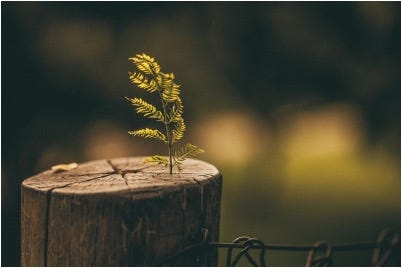
He sees a vision of a new little tree that’s going to come from one of the stumps in this broken forest. Included in the fallen trees of the nations and its leaders is the people of Israel. One of the fallen trees is the line of King David, whose father was named Jesse. Thus, it’s from the “stump” of that tree where Isaiah sees something unimaginable:
1 A shoot will come up from the stump of Jesse;
from his roots a Branch will bear fruit.
2 The Spirit of the Lord will rest on him—
the Spirit of wisdom and of understanding,
the Spirit of counsel and of might,
the Spirit of the knowledge and fear of the Lord.
(Isaiah 11:1-2 NIV)
Isaiah sees something really good coming out of the ashes of mankind’s broken leadership. He sees a new kind of leadership that will be marked not by human power, but by the Spirit of the Lord. He then goes on to say in this chapter that out of this new leadership, the “wolf will lie down the lamb” and peace will spread across the earth.
Of course, this was the promise of a Messiah—One who would rise from the line of David and become a healing tree that would restore the earth. What we learn through the prophecy is that this Messiah would do this work of healing through a unique expression of God’s Spirit. This expression is then described in seven different ways.
Seven in the number of fullness. This meant the Messiah would carry and operate in the fullness of the Holy Spirit.
When the Messiah showed up on the scene, he said to his followers: I am the center vine—you are the branches.
It turns out that we, the followers of Jesus, are the branches on this tree Isaiah saw.
That means the fullness of the Spirit is meant to flow through us.
There is no greater pursuit than to know and experience the Holy Spirit. This is our greatest inheritance. Everything built on man’s ways and man’s power (what the scriptures call the ways of the “flesh”) is going to crumble. But the life of the Spirit will last forever.
I want to invite you into a greater connection and intimacy with the Spirit of the Lord, and with that, to look at some of the mysteries of how the Spirit flows in and through our lives.
Isaiah and John
Over the years, there have been people who have seen the connection between Isaiah’s prophecy and something the apostle John was shown in the book of Revelation:
2 Immediately I was in the Spirit; and behold, a throne was standing in heaven, and One sitting on the throne... 5 Out from the throne come flashes of lightning and sounds and peals of thunder. And there were seven lamps of fire burning before the throne, which are the seven Spirits of God.
(Revelation 4:2, 5)
Throughout Revelation, John’s sees a lot of temple imagery. When it says there were “seven lamps” burning before the throne, this is very clearly pointing to where in the Temple there was a lampstand with seven burning lamps on it. This is known as the “menorah.”
As we can see in this image, there is a clear connection between the menorah John saw and the seven aspects of the Spirit Isaiah proclaimed. There’s the Spirit of the Lord, and then its pairs: wisdom and understanding, counsel and might, knowledge and the fear of the Lord. We’re going to look at all of these and how these are meant to function in our lives.
First, we need to go back thousands of years, before John and before Isaiah, to when God originally gave the design of this menorah. He gave it to Moses on a mountain. Similarly to Isaiah, this happened while the people of Israel were engaging in great darkness. Moses was having an encounter with God on the mountain while the people down below were worshipping a golden calf (which then turned into a demonic party).
In the midst of this, God shows Moses another golden image—not a golden calf, but a golden tree. He tells Moses that instead of planting this tree, he is going to build it. And this tree will reveal something that will heal the brokenness of this world.
The golden tree is the seven-branched menorah. It was fashioned after an almond tree. The almond tree would be known in Israel as the first tree to awaken from the sleep of winter. This is why the word “almond” in the Hebrew has to do with open eyes—being awake.
The function of this lamp-tree was to give light in the Holy Place of the Tabernacle that Moses was told to design. Its purpose was much more than that though. This purpose was so weighty that it would take thousands of years to unfold its meaning its meaning. This was a mystery—a riddle that God gave to Moses.
Fast forward 1,500 years to when the Messiah finally appeared. Jesus ascended to heaven and poured out his Spirit after sending his apostles into the world. One of them—John—was given a very important vision. We call it the Book of Revelation. In the beginning of this vision, before he sees the throne, John sees the golden almond tree God told Moses to design all those years ago. Jesus finally explains the meaning of this tree.
He says to John: This strange lampstand … is My Church (Revelation 1:20).
Suddenly, the riddle begins to unravel. The image starts making sense.
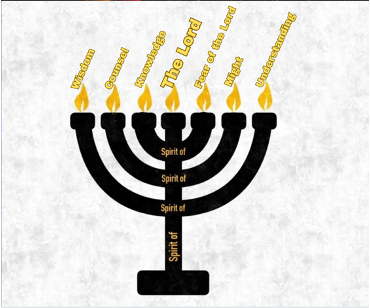
But we have to combine this something else John learns in his vision. John is told that the number six is the number of “man” (Revelation 13). The menorah has six branches that come together into a seventh piece. Again, seven is the number of completion. Therefore, this is communicating something about humanity finding wholeness, fullness, completion.
Jesus said: I am the center piece…I am the vine. You are the branches. Remain and you will experience true life. You will bear fruit. Because from me will come the oil or the life of my Spirit. John recorded these things in his Gospel (John 15).
This menorah is a riddle that gives a picture of a redeemed humanity. It is a hidden word of God released to Moses and then to Isaiah. He also gave it to Jeremiah, Zechariah and others. They were all shown the same thing—that out of the ashes of this forest fire that sin created—devastating nations and people group—there will be a new tree that rises that will provide light to the world.
This will be like an almond tree in the winter—that even when the winter of sin still appears to be holding on, the tree will declare that the winter is defeated. It’s coming to an end. A new day has dawned. Spring is emerging, and our brokenness is not the end of the story.
Now, back to Isaiah: When he sees the tree, he’s told that it represents a Person. He says the Spirit of the Lord will rest on this Person. Then he gives six other descriptions of the Spirit that will flow through this individual.
As we already said, this prophecy about Jesus. However, Jesus would come to have a Body bigger than his own human frame. We are his body. We are mystically united with Christ. This is Ephesians 2. This is the Gospel. We are made one with Christ in death and resurrection and his ascension to heaven.
We are raised up and seated with him.
Thus, this vision is truly about us, and how the Spirit will flow through the church to bring healing.
The Science of the Rainbow
Let’s switch gears for a moment and talk about the science of color.
You might be familiar with the fact that all colors of the rainbow exist within white light. I want to take some time to explain this because God has hidden more mysteries in the design of light itself. We’ll see here how the “book of Scripture” and the “book of creation” come together in more ways than we can imagine.
Light travels as waves of energy. It’s called a wavelength. A wavelength is simply the distance between one wave crest and the next. Longer wavelengths carry less energy and they appear to us as reds. Shorter wavelengths carry more energy and appear as blue or purple. So different colors are the same light, but they are spaced differently.
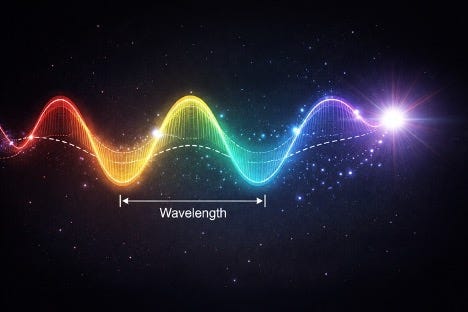
So how do you get white light? White light is formed when all the different wavelengths travel together balanced as a single beam. None of the colors disappear; they overlap so completely that our eyes perceive them as one unified brightness instead of separate hues. White light is not a single color—it’s the harmonious presence of all colors at once.
Let’s talk about a prism.
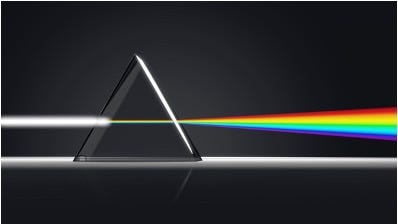
When white light enters a prism of glass (a raindrop has a similar effect), the light slows down and bends, but each wavelength within it bends by a slightly different amount. This causes the colors that were traveling together to spread apart, and it reveals this spectrum we call a rainbow. The prism or raindrop doesn’t create the colors, it just gives space for what was unified to now become visible.
You can imagine a choir singing. One singer alone and you hear a clear, distinct voice. That’s like an individual color. When several singers come in with different notes, that’s where harmony begins. And when all voices sing together in balance, you no longer hear individuals—you hear fullness. It’s like one Voice, even though it’s not—but it is!
That fullness is white light. The voices don’t disappear. They’re just integrated perfectly as One.
Now, the human eye is designed to clearly pick up six unique colors. The light spectrum is much more intricate than that, but it’s six colors that really stand out. Now, you might be familiar with the idea of “seven colors” of the rainbow. The reason for that is this fellow:
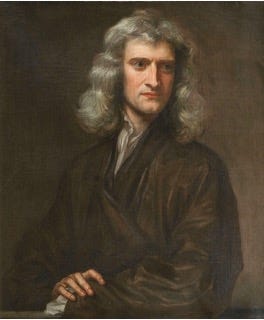
Isaac Newton was a strong believer in Jesus—and he loved the number seven. Also, there’s more to that choir analogy, because there’s another connection here to the seven notes of the musical scale. (See Addendum)
Isaac wanted seven colors to match the seven notes, and also wanted to bring in the overarching symbolism of the number seven throughout scripture. Hence, he was the one who took purple and split it into indigo and violet so he could his nice number seven. What we’re going to find out, however, is that he missed an opportunity to see that the six colors all combining into one white light is the more powerful biblical image.
The book of Scripture says this: God is Light (1 John 1:5)
The apostle John wrote those words. Now that we’ve looked deeper into the book of creation, we can discover more of what this means. God is perfect white light; yet within God is distinction and diversity. It reminds us of the Trinity, the reality of a unified God who is mysteriously comprised of Three Persons. (This connects to a Trinitarian revelation in that there are three primary colors, which we’ll get to in the next section.)
But let’s focus in on the rainbow and the way that it appears to the human eye as six distinct colors. This gives us incredible insight into what humans (represented in the number six) really are. It shows us how we come from the very Light or Substance of God.
This means our body is like a prism, where God’s eternal glory is slowed down—like a light wave gets slowed down through glass. God’s glory gets slowed down into a created vessel to be revealed a unique way.
Each of us are a unique “color” revealing a part of the Eternal God. He has given us his glory—his very image and likeness—because we are his children. We come from him. Yet we all reveal a different aspect of him. Thus, the purpose of our lives is so much more than we could fathom. We would love and honor ourselves, and be at so much more peace with ourselves, if we could truly accept this.
Six, being the number of man, is not a bad number. God made man on the sixth day and he called it very good. Six colors coming together in One White Light speaks humanity finding completion in Christ.
Or you could say—Christ is our Completion. Jesus Christ is the complete revelation of who and what humans are. Jesus, the One Isaiah saw, embodies humanity as it was supposed to be. He is our true identity and our ultimate destiny.
We are not beasts. We are not evil by nature. On our own, separate from the source of light, is not good. But the truth of who we are is good. Very good.
There’s another powerful picture of these truths in John’s revelatory encounter. In Revelation 4:3, John looks and see a rainbow around the throne. Then in the next verse—4:4—John continues looking and sees 24 elders around the throne. The same word used for the rainbow that was around the throne is used for the 24 elders around the throne.
While we can’t expound on it here, the 24 elders represent people. Whether or not they are literal, they are standing in for others. They represent Jew and Gentile. The nations.
And here’s the point: The rainbow around the throne—and the people around the throne—are one in the same. John sees a rainbow and then sees the nations.
This is the reality of who we are really!
We are the radiance of God’s glory.
Let’s talk about one final moment of crisis and hope in the Bible… The story where the rainbow first shows up.
In the flood story, the whole earth is destroyed while Noah and his family go on. They are like a little shoot growing from the stump of a global mudslide. This family is then given a promise sealed by a spectrum of light in the sky.
Hopefully you can see now that this famous promise is more than God saying, “I won’t flood the earth again.” The promise has to do with the revelation of humanity shining with the true glory of God.
If you go back to Isaiah 11 and you keep reading the full prophecy (after he discusses the Seven Spirits), Isaiah gives this remarkable promise:
…For the earth will be filled with the knowledge of the Lord as the waters cover the sea.
(Isaiah 11:9b)
There are so many things connecting here… The waters covering the earth reminds us of Noah. But now we know more of what the rainbow means. It’s that the earth will be filled with God’s glory (Habakkuk 2:14).
And what is God’s glory?
It’s us!
We are his Glory, made in his image. It doesn’t say the earth will be filled with the glory of the Lord . . . it says the earth will come into the “knowledge” or “awareness” of the Lord. In other words, we will wake up to who we really are—light of eternal Light!
The church—like an almond tree in winter—is the first-fruits of the Glory appearing on earth. We are called to manifest the true design of humanity.
When we realize we are one with Jesus—and we rest in this truth—we become the “light-filled branches” that we truly are.
Let’s look one more time at the menorah:
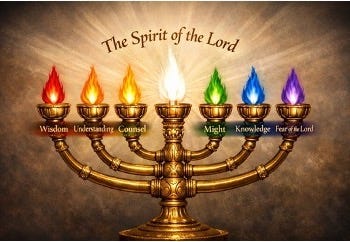
Here, we placed the order of the Seven Spirits differently to show the color progression. In the next part, we will talk look more closely at the seven Spirits and look at the connection between each one and the colors of light.
In closing here, I just want to point out that it’s interesting how the menorah looks like an upside rainbow. In light of everything we’ve discussed, this makes sense if we are indeed God’s glory on earth.
Think about this: A true rainbow is a circle (though it usually doesn’t appear that way because it’s blocked by something in the atmosphere). The menorah is thus an image of God’s glory on earth underneath the rainbow of God’s throne above.
Yet it’s all meant to be One, which is what a circle points to: Unity.
We’ll dive into this glorious Unity together in the next part…
Addendum:
Sound, Waves, and the Sevenfold Pattern
The connection between the seven Spirits and the musical scale is not merely poetic but rests on the shared nature of light and sound as waves. Though one is perceived by the eye and the other by the ear, both arise from vibration, frequency, and ordered resonance. Light appears to us as color when electromagnetic waves oscillate at different frequencies; sound appears as pitch when air vibrates at different rates. In both cases, what we experience as beauty or harmony is the result of invisible movement ordered by law.
Music, like light, is structured around a sevenfold pattern. The diatonic scale—do, re, mi, fa, sol, la, ti—contains seven distinct notes, yet it is not linear in the way it first appears. The eighth note is not something new; it is the beginning again. “Do” returns, but at a higher frequency—an octave above the first. What seemed like an ending becomes a deeper beginning. Completion gives way to transfiguration.
This mirrors the biblical logic of the seven Spirits of God (Isa. 11:2–3). The fear of the Lord, listed last, is not a dead end or a diminishing state. Like the seventh note of the scale, it carries within it the momentum of return. Fear of the Lord does not cancel wisdom; it refines it. It leads back to wisdom again, but now with reverence, humility, and clarity born of encounter. Wisdom on the far side of awe is not the same wisdom with which one began—it is wisdom in a new “octave.”
Musically, the seventh note (“ti”) is uniquely charged. It is called the leading tone because it longs for resolution. It creates tension not to frustrate the listener but to draw the ear forward. Its instability is purposeful; it leans toward rest. In the same way, the fear of the Lord introduces a holy tension into the soul. It unsettles self-sufficiency and false mastery, orienting the heart toward surrender. That surrender, paradoxically, is what opens the way to deeper wisdom.
This cyclical movement—progress that returns, ascent that circles back—reflects a fundamental pattern of creation. Just as a rainbow is not truly a straight band but a circle seen only in part, so spiritual growth is not a straight climb but a spiral. Each revolution carries us forward, yet also brings us home again, to truths we have known before but now perceive with greater depth.
Thus, the seven notes of the scale offer more than an analogy; they provide a sonic parable. Harmony is not achieved by abandoning the beginning, but by returning to it transformed. The end does not negate the beginning—it fulfills it. In both music and the life of the Spirit, fullness is not found in stopping at seven, but in allowing the seventh to lead us back to the first, now resonating at a higher frequency of glory. We will explore this in much more depth in the next section.
💎 🌾 💎
Join us in impacting lives across the 10/40 window—your gift goes entirely to this mission. Learn more in the link below.