


A shoot will come up from the stump of Jesse;
from his roots a Branch will bear fruit.
The Spirit of the Lord will rest on him—
the Spirit of wisdom and of understanding,
the Spirit of counsel and of might,
the Spirit of the knowledge and fear of the Lord.
—Isaiah 11:1–2 (NIV)
Returning to the Treasure Chamber
Before continuing this treasure hunt, it is worth pausing to regain our bearings. It had been several weeks since the previous message in this series, and the response afterward confirmed something I sensed even while speaking: there is a hidden chamber of spiritual riches contained within this vision of the Seven Spirits of God. Whenever Scripture begins to open like that—when patterns start appearing across passages separated by centuries—it is usually a sign that the Lord is inviting us to look more closely.
In the earlier message, which I called The Way of Life, we discovered that the Seven Spirits of God are not simply a list of spiritual attributes that believers are meant to cultivate. Rather, they describe the very pathway of divine life itself. They reveal the inner movement of Christ’s own life as it flows toward us and through us.
We began with the Spirit of wisdom, which shows us what life actually looks like when it reflects the heart of God. Wisdom is not primarily cleverness or strategy; it is the shape of self-giving love. Christ crucified is the wisdom of God, and in that sense wisdom is the first color in the spectrum of divine light breaking into the world.
From wisdom we moved into understanding, which awakens us to why this way of life is both necessary and beautiful. Understanding allows us to perceive the goodness of wisdom from within rather than merely observing it from the outside.
Then comes counsel, which reveals how this wisdom becomes practical within the ordinary decisions of life. The Spirit of might follows, supplying the resurrection power required to actually live what counsel reveals. Wisdom may show us the way, but it is might that enables us to walk in it.
As these realities begin to mature within a person, they give rise to knowledge—not information about God, but a lived and relational knowing of Him. Truth moves from doctrine into experience. God is no longer simply someone we believe in; He becomes someone we know.
From this intimacy emerges the fear of the Lord, the final Spirit named in Isaiah’s list. This is not fear in the sense of anxiety or distance, but awe, wonder, and surrendered reverence before the beauty of who God truly is. Yet even here the movement does not end. Like the rainbow itself, which forms a circle rather than a straight line, the fear of the Lord becomes the doorway into a deeper wisdom. We return again to the self-giving love revealed in Christ, but now with a greater clarity than before.
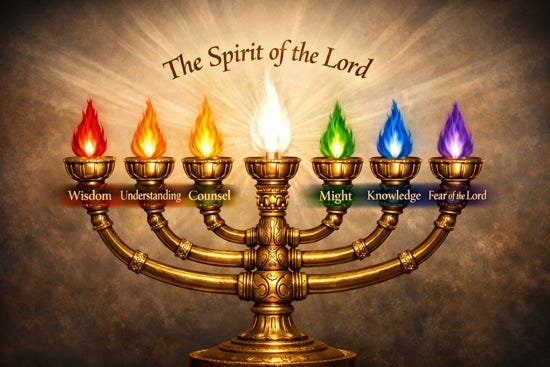
The sevenfold Spirit of God is therefore not merely a structure of spiritual virtues; it is the rhythm of divine life itself. It is the movement of wisdom, power, intimacy, and worship that exists eternally within the Trinity, and into which humanity has been invited.
A Lampstand Community
One question naturally follows from this: what happens when an entire community begins to live within this rhythm?
When the sevenfold Spirit becomes the shared atmosphere of a people rather than the private experience of individuals, something remarkable begins to emerge. The community itself becomes a living lampstand. The church begins to burn together with the fire of the Spirit in a way that reflects the fullness of Christ more clearly than any single believer could express alone.
It is not surprising that different aspects of the Seven Spirits often correspond to different expressions of ministry within the body of Christ. Wisdom, understanding, and counsel frequently appear in pastoral care and spiritual direction. The Spirit of might is often visible through healing, deliverance, and miracles. The Spirit of knowledge is closely connected with prophetic insight and teaching, while the fear of the Lord finds its natural expression in worship and prayer. Yet the goal is not specialization alone; it is harmony. The dream is to see entire communities shining with the fullness of the Spirit so that every branch participates in the light.
This is how the church becomes a true witness to the Way, the Truth, and the Life.
The Center Pipe: The Spirit of the Lord
If this is the vision, the next question becomes deeply practical: how do we actually enter into this flow?
Isaiah begins with a statement that at first glance seems almost too simple to carry such weight:
The Spirit of the Lord will rest on him.
The key word here is rest. The movement of the Spirit described in Isaiah does not begin with effort, strategy, or discipline. It begins with rest.
Our calling is not to force our way into wisdom or power or intimacy. It is to enter into the rest in which the Spirit already dwells.
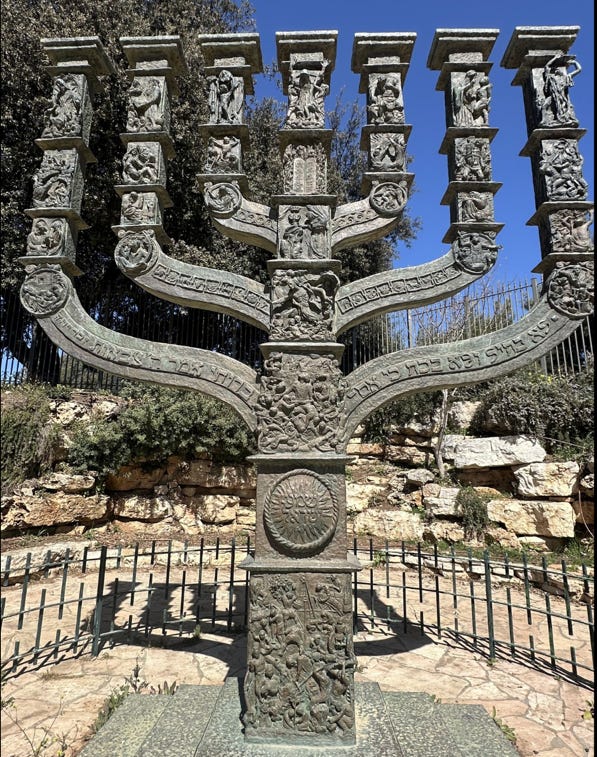
During a recent visit to Jerusalem, I stood near the great menorah positioned outside the Knesset, Israel’s national parliament. The placement of that lampstand is striking. At the visible center of Israel’s political authority stands a symbol pointing toward another kind of authority altogether—the authority of the Spirit resting upon a human life. For those familiar with the imagery of the almond branch in Scripture, the meaning is difficult to miss. The menorah represents the Seven Spirits of God burning upon the Messiah, yet the New Testament also tells us that the lampstands represent the churches themselves. The life that rests upon Christ is meant to flow through His people.
In this sense, the church participates in a hidden form of governance in the world. Like Esther standing before the king, the people of God influence history through love and intercession in ways that are often invisible but deeply real.
Zechariah’s Vision of Overflow
The prophet Zechariah was later given a vision of a lampstand that differed in one important respect from the design given to Moses. In the tabernacle menorah each lamp had to be lit individually by the priest. In Zechariah’s vision, however, the branches were hollow and connected to a central source so that oil flowed naturally from the center outward into the six surrounding lamps.
The center received the oil first, and the branches received the overflow.
Because oil throughout Scripture consistently represents the Holy Spirit, the meaning becomes clear. The life of the Spirit flows first into the Messiah and then outward into those who are joined to Him.
The question that remains is how we participate in that overflow. Once again the answer leads us back to the same word Isaiah used: rest.
The Pattern of the Seventh Day
The Hebrew word translated rest in Isaiah appears again in the account of creation:
For in six days the Lord made the heavens and the earth… and rested the seventh day.
—Exodus 20:11
The pattern is difficult to ignore. Just as the menorah contains six branches connected to a central stem, creation itself unfolds across six days and culminates in a seventh day of rest.
Adam was created on the sixth day. This means that his first full day of existence was not a day of labor but a day of participation in God’s rest. His introduction to life itself began with enjoyment rather than effort. Before he was ever asked to cultivate the garden, he was invited to receive it.
This is not a small detail in the story of creation. It reveals something essential about the structure of human life as God intended it to be lived.
Abiding in the Vine
Jesus later spoke directly into this same mystery when He said,
I am the vine, you are the branches… apart from Me you can do nothing.
—John 15:5
For many believers, this passage becomes a turning point. I remember encountering it early in my own life with Christ and recognizing immediately that it contained something central. Throughout church history, some of the most perceptive voices in the spiritual tradition have returned again and again to this invitation to abide. There is a reason for that. Jesus was not offering advice here; He was describing the secret of spiritual life itself.
If His followers learn to remain in Him, everything else follows. His courage becomes their courage. His wisdom becomes their wisdom. His love begins to flow through their relationships. The same pattern appears again: Isaiah speaks of rest, Exodus reveals the Sabbath, Zechariah describes the flowing oil, and Jesus calls His disciples to abide.
When a person begins to recognize this pattern and shape life around it, something unusual begins to happen. Grace begins to flow in ways that cannot easily be explained by effort alone. Favor appears where striving once dominated. From the outside it can almost look as though something unfair is taking place.
In one sense, that impression is not entirely wrong.
You are cheating death.
You are cheating fear.
You are cheating sorrow.
You are learning to live from the life of Christ rather than from your own strength.
Wisdom Before Creation
Still, the question remains: what does abiding actually look like in practice?
To answer that question Scripture takes us somewhere unexpected—not only to Genesis, but to a place even earlier than Genesis.
In Proverbs 8 wisdom suddenly begins speaking as a person. At first the book of Proverbs describes wisdom as guidance for living well, but then something shifts. Wisdom begins to describe events that took place before the foundations of the earth were laid. As she speaks, we begin to recognize language that echoes Isaiah’s description of the sevenfold Spirit.
Wisdom says,
Counsel is mine… I am understanding… I have strength.
Within only a few verses we encounter wisdom, understanding, counsel, might, knowledge, and the fear of the Lord gathered together in one voice. The pattern of the seven Spirits appears again, but this time it appears within a conversation that reaches back into eternity itself.
Then comes the remarkable statement:
By me kings reign.
This language reminds us once again that the sevenfold Spirit is connected with authority. Those who learn to live within this flow begin to participate in the hidden governance of God’s purposes in the world.
The House with Seven Pillars
The next chapter continues the same imagery:
Wisdom has built her house;
she has hewn out her seven pillars.
—Proverbs 9:1
Here the sevenfold pattern appears again, this time as a house supported by seven pillars into which Wisdom invites us to enter. Immediately afterward she prepares a table and extends an invitation:
Come, eat of my bread
and drink of the wine I have mixed.
It is difficult to miss what this imagery suggests. The entrance into the house of Wisdom is not achieved through effort but through participation at a table. Bread and wine appear once again as the means by which the life of God is received rather than produced.
The Secret of Sabbath Trust
When Moses established the Sabbath commandment, he did not forbid activity altogether. What he forbade was the kind of labor that arises from anxiety about provision. The Sabbath was meant to remind Israel that their lives were sustained not by their own effort but by the faithfulness of God.
Rest, in this sense, is another name for trust. And trust is another name for abiding.
It is significant that one of the central activities permitted on the Sabbath was shared meals. Even today the Shabbat meal remains one of the defining features of Jewish life. Families gather around a table not simply to eat but to remember that life itself is received as a gift.
When Jesus invited His disciples to abide in Him, He did so during a Passover meal—a Shabbat meal centered around bread and wine. Communion was not incidental to His teaching about abiding. It was the setting in which that teaching was given.
Receiving the Delight of the Father
Later in Proverbs 8 the mystery reaches its most beautiful expression:
Then I was beside Him as a master craftsman;
and I was daily His delight…
and my delight was with the sons of men.
Before creation began, the Father, Son, and Spirit delighted in one another. Yet within that eternal delight there was already a place prepared for humanity.
This same delight appears again at the Jordan River when Jesus is baptized and the Father declares,
You are my beloved Son; in you I am well pleased.
Then, only a short time later, Jesus speaks words that bring this entire pattern to its climax:
As the Father loved Me, I also have loved you. Abide in My love.
—John 15:9
This is the secret hidden within the pattern of rest. The overflow of the Spirit becomes accessible not through effort but through trust in the astonishing truth that the Father loves us with the very love He has always given His Son.
We are not invited to earn this love. We are invited to rest in it.
The bread is ready. The wine is mixed. Whatever barriers we imagine still exist between ourselves and God have already been removed in Christ. The oil of the Spirit is not something withheld from us until we prove ourselves worthy. It is something already given, waiting only to be received.
We learn to recognize its movement within us as we learn to rest in the delight of the Father.
💎 🌾 💎
Join us in impacting lives across the 10/40 window—your gift goes entirely to this mission. Learn more in the link below.