


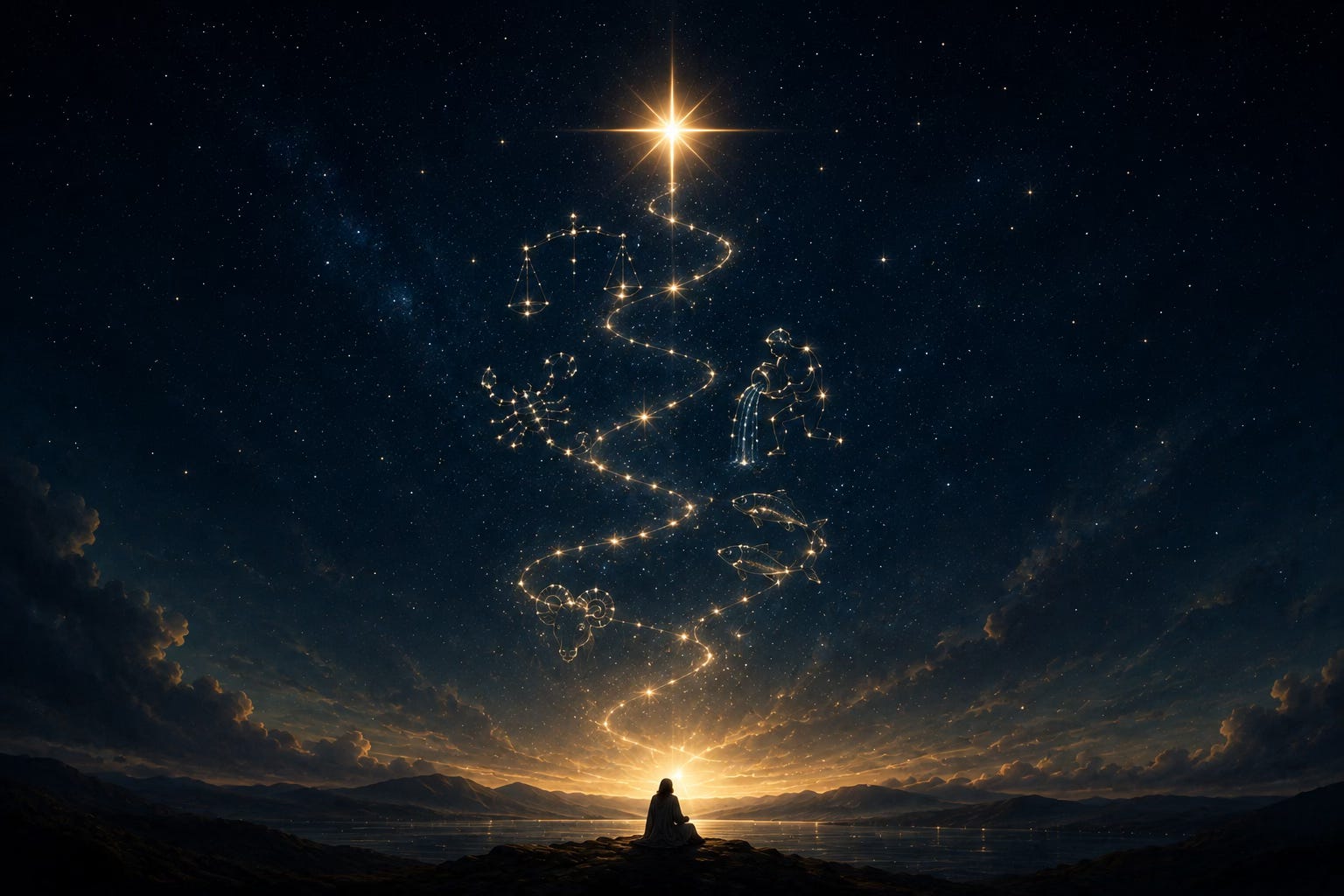
Throughout this series, we’ve been exploring the universe as symbolic architecture bearing witness to Christ. Like an enchanted cathedral, creation is filled with signs that point beyond themselves to a greater reality. Thus, we’ve followed the image of the Sower through the Carina Nebula, watched the heavens herald the birth of Christ in Bethlehem, contemplated Jesus as the Bright and Morning Star, and listened for echoes of the Trinity in the ancient idea known as the Music of the Spheres.
There is, however, one part of the stars we cannot avoid…
The zodiac.
For many Christians, that single word immediately raises red flags—and understandably so. Today, the zodiac is most commonly associated with horoscopes, fortune-telling, personality types, and the attempt to interpret human destiny through the movements of the stars. Scripture gives a stark condemnation to astrology and every effort to seek guidance from the heavenly bodies rather than from God.
But astrology may not be the original meaning of the zodiac…
For the constellations were not first arranged to tell us about ourselves, but Christ…
The Witness of the Stars
This was the proposal of nineteenth-century biblical scholar E. W. Bullinger in his remarkable work The Witness of the Stars. Bullinger argued that the familiar twelve signs of the zodiac preserve the remnants of an ancient celestial revelation: a pictorial proclamation of the Gospel written across the heavens long before astrology turned the signs inward toward human fate and personality.
His work remains controversial in certain areas of historical reconstruction. Not every proposed ancient name, meaning, or connection can be established with equal certainty, and some of Bullinger’s conclusions reach beyond what surviving evidence can definitively prove. Nevertheless, the sweeping picture he uncovered is difficult to dismiss as mere coincidence.
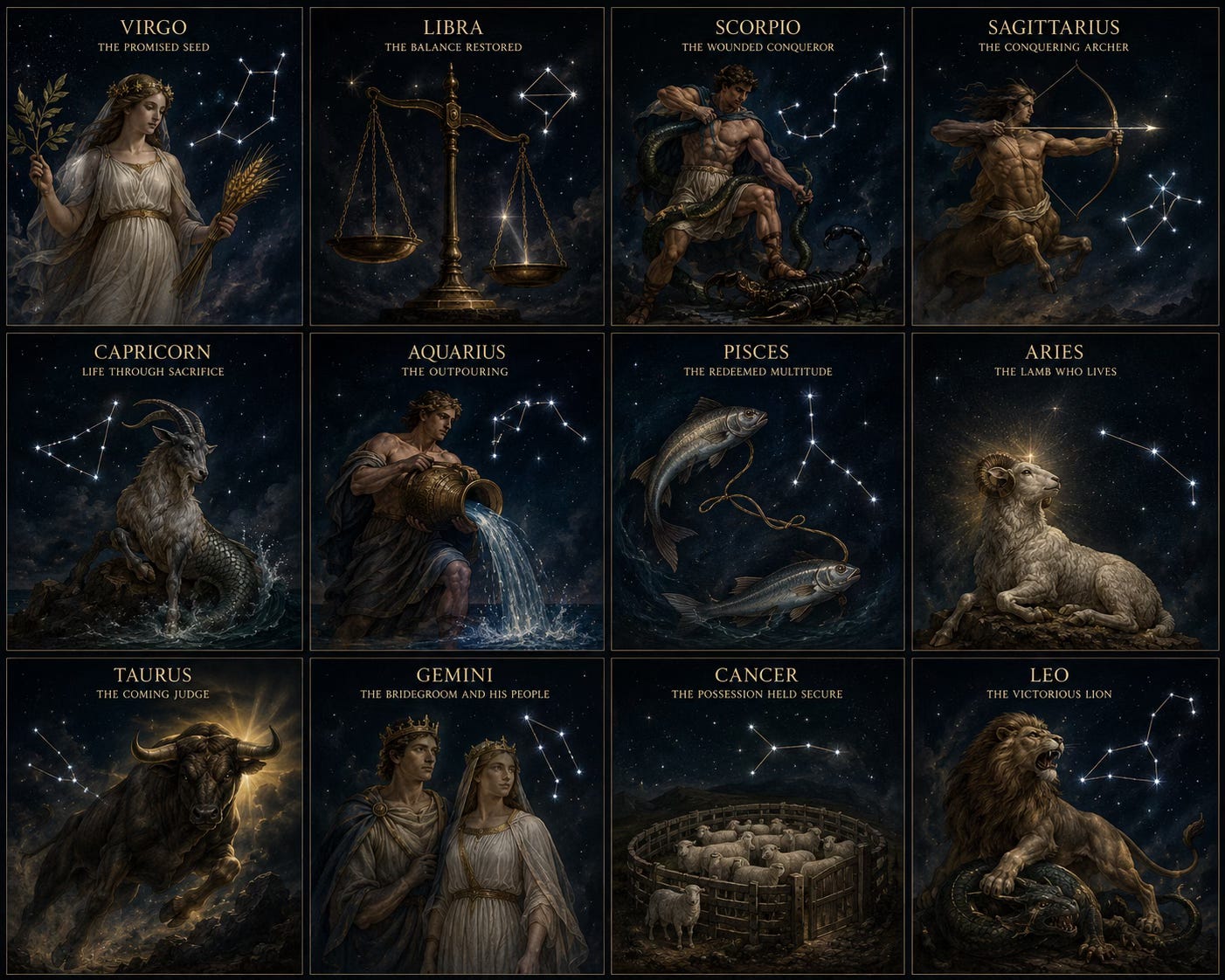
Read in their traditional order—not beginning with Aries, as modern astrology commonly does, but with Virgo—the twelve signs form a surprisingly coherent movement. They begin with the promised Seed of the woman, pass through conflict, sacrifice, suffering, resurrection, and the gathering of a redeemed people—concluding with the victorious Lion triumphing over the enemy.
It is the Gospel, written not in sentences but in a way of communication the ancient world would understand: images.
The Beginning: The Promised Seed
Bullinger begins the celestial story with Virgo, the Virgin.
In her ancient representation, the woman holds a branch in one hand and an ear of grain (or seed) in the other. The biblical resonance is immediate. From the opening chapters of Genesis, redemption is attached to the promise of the woman’s Seed:
“I will put enmity between you and the woman, and between your seed and her Seed; He shall bruise your head, and you shall bruise His heel.” (Genesis 3:15)
The Gospel begins with a woman and a promised Child. Isaiah later speaks of a virgin conceiving and bearing a Son. Jeremiah calls the Messiah the righteous Branch. Jesus identifies Himself as the grain of wheat that falls into the ground, dies, and produces an abundant harvest.
The first image in the ancient sequence is therefore not a warrior or a king, but a woman carrying the promise of life. The story begins with a seed.
The Price of Redemption
From Virgo, the signs move to Libra, the scales.
Modern astrology often interprets Libra in terms of balance, fairness, or personality. Bullinger saw something more ancient and far more significant: the scales represent a price weighed, a debt measured, and the need for redemption.
The message is that humanity has been weighed and found wanting. Things are out of balance and must somehow be restored.
This resonates beautifully with the biblical idea of righteousness. The Hebrew word behind righteousness was connected with ancient scales we see in Libra. Scales were used to weigh money, goods, and precious materials. A “righteous” balance was one that was true, accurate, and just.
Likewise, humanity was created to accurately reflect the image and likeness of God, living in harmony with His life and character. In this sense, “unrighteousness” is not about the breaking of religious rules, but the loss of this divine-human balance. Humanity is no longer reflecting its Creator as we were designed to.
The scales therefore raise a question that echoes throughout the rest of the story: How can what has fallen out of harmony be made whole again? The signs that follow answer this question reveal the sacrifice through which true righteousness would be restored.
The Conflict with the Serpent
The third sign is Scorpio, the scorpion.
Here the celestial story becomes openly violent. In the image, a scorpion reaches toward the heel of a coming conqueror. This immediately recalls the prophecy of Genesis—the serpent will bruise the heel of the woman’s Seed, but the Seed will crush the serpent’s head.
In traditional depictions surrounding Scorpio, a mighty figure struggles against the serpent while another figure presses his foot upon the enemy. The imagery is strikingly close to the Bible’s earliest prophecy of redemption.
The Messiah will be wounded, but the wound will not be the end of the story. The same heel that is struck will ultimately come down upon the enemy’s head.
The Conquering One
Next comes Sagittarius, the archer.
The figure is depicted as moving forward with bow drawn, an image of a conqueror going forth to victory. Bullinger connected this with the conquering Messiah: the One who enters the conflict not merely to survive the serpent’s attack, but to overthrow the powers of darkness.
Scripture repeatedly portrays the Lord as a divine warrior. His arrows strike the enemy. His truth goes forth. The Messiah appears not only as a suffering servant but as a victorious King. In other words, the promised Seed is no passive victim. He has entered the story of the heavens in order to conquer darkness.
Life Through Death
The fifth sign, Capricorn, is one of the strangest creatures in the zodiac: part goat and part fish.
Bullinger understood the goat as a figure of sacrificial death and the fish as a symbol of living multitudes emerging from that death. The image therefore presents a paradox at the very heart of the Gospel:
Life comes through sacrifice.
Jesus described this mystery through the image of a seed. We quoted it before:
“Unless a grain of wheat falls into the ground and dies, it remains alone; but if it dies, it produces much grain.” (John 12:24)
The Messiah gives His life, and through His death a multitude is born. What appears to be defeat becomes multiplication. The slain One becomes the source of an innumerable people.
The Outpouring of Living Water
Following Capricorn comes Aquarius, the water bearer.
A man pours an unending stream of water from a vessel, and the waters descend toward a waiting fish.
For Bullinger, the image spoke of blessing poured out upon the redeemed. The sacrifice has been made; now life flows from the victorious Redeemer to His people.
The Scriptures repeatedly use water as an image of divine life and the outpouring of the Spirit (Isaiah 44:3). When Jesus stood in the temple, he declared that rivers of living water would flow from those who believe in Him. John later explains that He was speaking of the Holy Spirit (John 7:37-39).
We see that the Gospel includes a promise not only to bring forgiveness, but to pour out true life upon the soil of humanity.
The Redeemed Multitude
The waters of Aquarius flow toward Pisces, the fishes.
In Bullinger’s reading, the two fish represent the people of God, bound together yet also restrained by a cord. One fish is directed upward while the other moves along the horizon, suggesting a people with both heavenly and earthly dimensions.
Whatever every detail may mean, the central image is clear: a multitude has emerged from the sacrifice and outpouring that preceded it.
Jesus called His disciples to become fishers of men. He compared the Kingdom to a net gathering fish of every kind. The earliest Christians even adopted the fish as a symbol of Christ and of their identity in Him.
The Seed has become a people and the solitary grain has produced a harvest.
The Lamb Who Was Slain
Next comes Aries, the ram.
Here the price suggested by Libra and the sacrifice pictured in Capricorn come into sharper focus. The ram recalls Abraham and Isaac, where a ram was provided in the place of the beloved son. It evokes the Passover lamb whose blood delivered Israel from destruction. Above all, it points toward Jesus Christ:
“Behold! The Lamb of God who takes away the sin of the world!”
In Revelation, the Lamb appears as though slain, yet He stands alive in the center of the throne. His apparent weakness is revealed as the power of God and His sacrifice becomes His victory. The Gospel’s conquering King is also its slaughtered Lamb.
And He overcomes not by avoiding death, but by passing through the death and robbing it of its power.
The Returning Judge
The ninth sign is Taurus, the bull.
The bull is a figure of tremendous strength, charging forward with its horns lowered. Bullinger understood it as an image of the Messiah returning in power and judgment.
The One who first appeared as the promised Seed and sacrificial Lamb will not remain hidden forever. The Gospel announces not only what Christ has done, but the ultimate unveiling of what His work has accomplished.
Every opposing power will fall and every crooked thing will be made straight. The King will establish justice throughout His creation. The bull advances because redemption is ultimately about the restoration of all things under their rightful Creator.
The Bridegroom and His People
Gemini, the twins, follows Taurus.
Bullinger interpreted the paired figures not as two competing personalities but as a picture of union: the victorious Messiah joined to His redeemed people—His Bride.
This is one of the great mysteries of the Gospel. Christ does not merely rescue humanity from a distance. He joins us to Himself.
He is the Head, and we are His Body.
He is the Bridegroom, and we are His Bride.
He is the Firstborn among many brothers and sisters.
The two figures belong together, distinct yet united. What is His becomes ours through participation in His life. The Gospel in the heavens is therefore not simply the story of a solitary Hero. It is the story of a Hero who brings a people into His own victory.
The Possession Secured
The next sign, Cancer, presents a more difficult ancient image because its familiar modern form as a crab does not communicate its meaning as clearly as some of the others.
Bullinger believed the familiar crab was not the original image. He based his interpretation instead on older representations such as the Egyptian scarab, the ancient name klaria—“the cattle-folds”—and star names conveying sheltering, gathering, and holding fast.
Bullinger associated it with the gathering and securing of the Redeemer’s possession.
The movement of the whole celestial story supports this theme. The Seed has come. The price has been paid. The enemy has been defeated. The sacrifice has produced a people. The waters have been poured out, and the redeemed have been united to their Lord.
Now the inheritance is held secure.
Jesus speaks of gathering His own. He declares that no one can snatch His sheep from His hand. Paul writes that creation itself waits for the revealing of the sons of God. Revelation portrays the redeemed gathered around the throne from every tribe, language, people, and nation.
The Lion of Victory
The final sign is Leo, the lion.
The celestial story that began with the Virgin ends with the Lion. The promised Seed has become the conquering King.
Leo is depicted springing upon the serpent, bringing the ancient conflict to its conclusion. The enemy introduced near the beginning of the biblical story is finally crushed beneath the authority of the Messiah. The imagery reaches its fulfillment in Revelation:
“Behold, the Lion of the tribe of Judah, the Root of David, has prevailed.”
This is the culmination of the Gospel. The Lion triumphs and the deceptive serpent falls.
The story ends where all Scripture ends—not with evil endlessly opposing good, but with Christ victorious and creation restored beneath His reign.
A Story Written in Light
Taken together, the twelve signs present an extraordinary sequence:
The Virgin bears the promised Seed.
The scales reveal both the need and price of redemption.
The scorpion wounds the coming Conqueror.
The archer rides forth to victory.
The sacrificial goat gives rise to living multitudes.
The water bearer pours out blessing.
The fishes portray the redeemed people being brought in.
The ram reveals the slain Lamb.
The bull advances in restorative judgment.
The twins picture union with our Redeemer.
The gathered possession is held secure.
And the Lion crushes the serpent and reigns.
Was every element of this sequence perfectly preserved through history? Almost certainly not. Ancient images have shifted, names have changed, cultures have borrowed and corrupted symbols, and centuries of astrology have obscured whatever original testimony may once have been present.
But Bullinger’s central insight remains breathtaking.
The zodiac may once have been something entirely different from the horoscope.
Before it became a way of predicting human personalities and destinies, it may have been a celestial proclamation of the destiny God had prepared for creation in His Son.
So while astrology asks what the stars say about us, the ancient witness of the stars was instead pointing to our Savior and Redeemer.
💎 🌾 💎
Join us in impacting lives across the 10/40 window—your gift goes entirely to this mission. Learn more in the link below.