


The following article is the first in a new series exploring the witness of the Gospel throughout creation. These reflections grow out of direct experiences with the Lord—experiences that are linked to Scripture, but then affirmed through what theologians call “the book of creation.” Again and again, I have found that when these two witnesses are read together (always with Christ at the center), God speaks in ways that deepen wonder and illuminate the beauty of the Gospel.
This series will not be about hidden codes in the stars or secret meanings buried in nature. Rather, it explores how creation itself functions as a parable, an echo of the same story Scripture proclaims from beginning to end.
In this first entry, I share a trail of what felt like divine breadcrumbs that led me to a remarkable region of space—the Carina Nebula—where I discovered imagery that reflected the Gospel in surprising ways.
The Sower in the Stars
Genesis opens with a curious statement about the “lights” in the heavens:
“Let there be lights in the expanse of the heavens… and let them be for signs.” —Genesis 1:14
From the beginning, Scripture suggests the stars are not merely decorative. They shine physically upon the earth, and they also shine symbolically. Throughout the Bible, light represents revelation, which is why we find the heavens are actually participating in telling the story of God.
Now, this is not about astrology or hidden codes. To put it simply, creation functions as a parable. The universe is singing a song . . . and the song carries the most incredible message you could ever take into your ears (and eyes) . . .
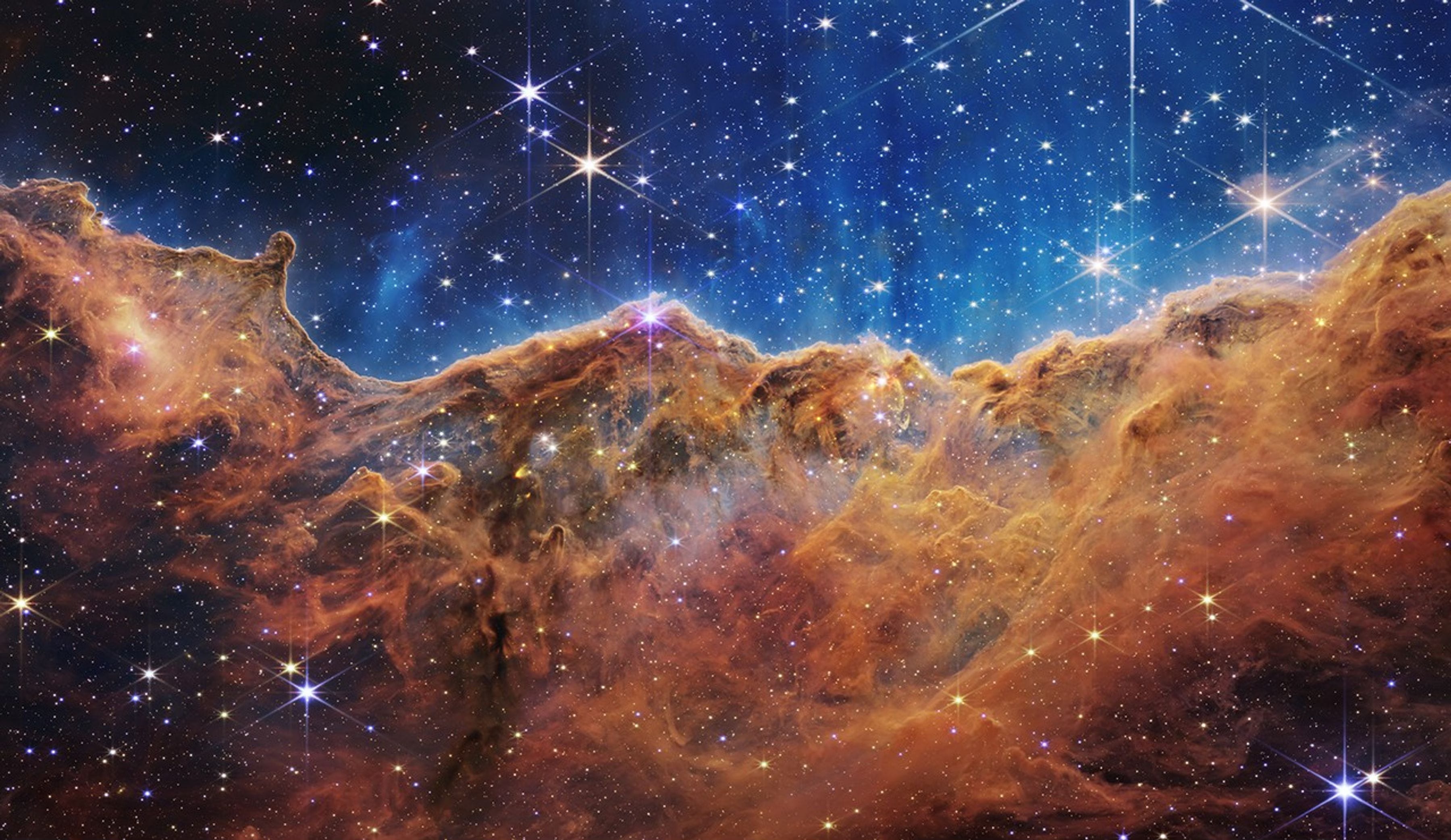
A number of years ago I felt impressed to open a book I’d been gifted called Far Out. It’s one of those massive coffee table books filled with pictures of the universe. I happened to open to a photograph of towering pillars of gas within the Carina Nebula. Here, the authors pointed out something remarkable: if you zoom into one part of this nebula (see above), you’ll find a shape that resembles a sower scattering seed.
This immediately called to mind Jesus’ parable:
“Listen to this! Behold, the sower went out to sow…” —Mark 4:3
In this case, however, the seed was not grain. It was stars.
Seeing that image stirred something deeper in me. I went to Genesis 1 which describes a pattern in creation: things are formed after their kind. Living things, in particular, carry seed within themselves. Trees bear fruit containing seed. Creatures multiply according to their nature.
But before the creation of plants or animals, God created the stars.
Modern astronomy tells us something astonishing: stars carry “seed” as well. When they die, stars scatter the material from which future stars—and even planets—are formed. In a very real sense, stars multiply after their kind.
Creation itself follows the pattern of the Sower.
From Star-Stuff to God-Stuff
The astronomer Carl Sagan famously said:
“We are made of star-stuff.”
There is truth in this observation. The elements in our bodies were forged in ancient stars; however, Scripture tells a deeper story. Humanity is not merely made from stars. We are made from something—or Someone—far greater.
We see this in the progression of Genesis 1. Creation itself moves from stars, to seeds, to living creatures, to humanity. Each stage reveals a multiplication after its own kind.
But the greatest Mystery comes when God says,
“Let Us make man in Our image.”
Just as fruit carries the seed of the tree that bore it, humanity carries the life of the One who formed us. Creation reaches its climax in this ultimate reproduction: God himself birthing something after his own kind.
The Bright Star at the Center
With this, I became infused with wonder over the fact that the stars might be heralding this exact message to humanity—which was strengthened as I read further on regarding Carina . . .
At the heart of this nebula, there lies a remarkable star system called Eta Carinae. This is one of the most massive and luminous stellar systems visible from Earth. Being one of the brightest stars that God’s kids can look up and behold, you might imagine there is something important that it’s “heralding.”
First, eta means seven. It is catalogued as the seventh star in the Carina constellation. I could go into the connection between the number seven, the seventh day of creation, and the finished work of Christ—but I’ll hold off for the moment. Right now, I want to focus more on why this star is so bright.
Scientists have discovered that what originally appeared to be a single star is actually two stars orbiting each other—a binary system whose radiating light shapes the dramatic pillars in the surrounding nebula. This is what is causing us to see images such as the sower scattering seed.
Upon discovering this, I saw a living parable written in the heavens. These two stars orbiting each other reflects God’s design of relationship. Within that, it speaks of the original and eternal Relationship from which everything else came. The two stars circling one another speak of the Father and Son eternally giving and receiving each other’s love. The Holy Spirit is the Light of that Love. The Spirit is the warmth in which the Father and Son bask, and it is this warmth that shines out and births other things around it.
Thus, we find a picture of the Trinity as they sow life into the universe.
The Seed That Must Die
As I continued pondering what I was seeing in Far Out, I decided turn my Bible from Genesis 1 to 1 Corinthians 15. I was looking for Paul’s statement about how stars differ in glory from one another. When I got there, I noticed something I never saw before, in the verse immediately preceding Paul’s words about stars:
“What you sow does not come to life unless it dies.” —1 Corinthians 15:36
In this passage, Paul moves seamlessly from seeds to stars! After already meditating on the connection between seeds and stars in Genesis, I was blown away by seeing a parallel in Corinthians.
Creation truly shares a pattern from the highest heavens to the soil under our feet. A pattern that shows seeds dying and multiplying.
And this is truly the Gospel, a reality written into the fabric of the cosmos. This is what the finished work of Christ is all about. Jesus’s death and resurrection was about restoring our original identity as image-bearers.
Now, to reiterate our earlier disclaimer, this doesn’t mean we’re making a doctrine through telescopes. Rather, we’re discovering doctrine echoed in creation’s light. This is the illuminating poetry of the Gospel sending out its message for those with eyes to see.
The Key in the Nebula
The next thing I discovered was that within the Carina Nebula also lies a formation known as the Keyhole Nebula.
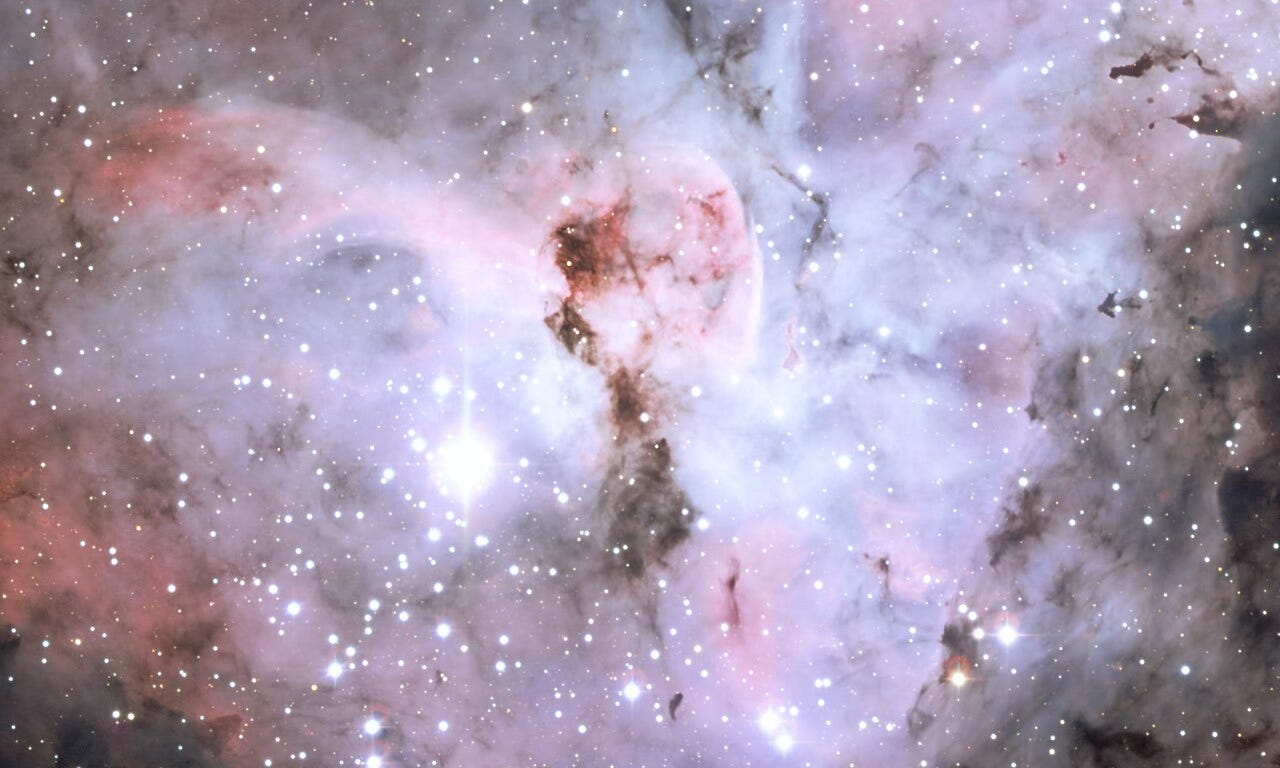
Think of it. God designed both the spectrum of light and the highly complex human eye that can take it in perfectly. Unlike any other created being, humans have the unique ability to see images in the heavens and make symbolic connections. With that mind, consider that humankind has discovered an image of a keyhole found in the middle of this already-prophetic stellar nursery.
A seed-bed of stars surrounding the shape of a key.
Jesus talked about “the keys of the kingdom.” The universe itself seems to whisper the same truth.
There is a key that unlocks the meaning of creation.
That key is Christ and his Gospel—i.e. what happened through his finished work on the cross.
Discovering this key unlocks our understanding into the very “theme” behind creation’s story.
And it is also a musical key. It helps tune us to the song of creation as well.
After Their Kind
So, let’s return to Genesis 1 and this repeated phrase scattered throughout the text: “. . . after their kind.”
Plants after their kind, creatures after their kind, any living beings after their kind. And then comes the human race, where God declares that they are “made in Our image.”
This is what the light is pointing us to. This is the key to understanding what our lives are really all about.
The heavens are inviting us to lift our heads, not only to gaze at the beauty of colorful nebulae, but to lift our awareness of who we are. We are not some complicated computer in a skin-suit designed to look and act like our Programmer. There are hints of that in our design, but the truth is so much more wondrous.
In reality, we are children who we are born from God in the way a new star emerges from a dead one, or a plant comes from a geminating seed. We are the very life of God. As Jesus is the eternal Son of God, humanity can likened to the daughter of God, a precious child fashioned in the same image as our Elder Brother.
If you read ahead in Genesis, this message comes out plainly when we see how humans go on to multiply themselves:
“Adam fathered a son in his own likeness.” —Genesis 5:3
This is the same terminology used for God making Adam. It helps us see what image really means. It’s about children who share the very life of the parent.
All of this illuminates(!) the meaning of Christ’s coming and his work on the cross. This Gospel story is not only about the glorious and generous gift of forgiveness (though that is a central need for the human heart). Jesus’s coming is about the redemption of divine sonship/daughterhood.
And creation itself has been pointing toward this from the beginning! The stars are shining with its message. They are a singing its song over us . . .
With that, we’ll go next to the Star of Bethlehem, an actual cosmic event that pointed the way toward everything we’re attempting to describe here.
Until then . . .
💎 🌾 💎
Join us in impacting lives across the 10/40 window—your gift goes entirely to this mission. Learn more in the link below.
Wow, just wow!