


The Heavens Declare
Last time we looked at the ancient zodiac and the very real possibility that this was one of God’s first presentations of the Gospel, written in bright lights and celestial signposts, which lines up beautifully Genesis 1 where the lights of the heavens are appointed “for signs.” Psalm 19 witnesses to the same mystery when it describes the heavens as pouring forth speech without words to every part of the earth.
That speech, it seems, possesses a storyline.
The constellations that the human visual cortex (combined with the powers of a metaphoric and narrative-loving mind) has naturally put together are not merely twelve disconnected pictures, but twelve windows within the same celestial cathedral. Each illuminates another movement in the drama of redemption: promise, conflict, sacrifice, outpouring, union, restoration, and triumph.
If this is true, then Scripture gives us the interpretive lens through which we can better understand what creation has been saying all along.
And what is even more beautiful is that the heavens do not proclaim “another gospel,” which Paul warned us to reject. Rather, they herald the same Gospel in another language. One is written with ink; the other is written with electromagnetism. Long before apostles carried the Gospel throughout the earth, its outlines may already have been shining above them.
And both direct our gaze toward the promised Seed, the slain Lamb, the heavenly Bridegroom, and the victorious Lion.
The heavens were never intended to tell us who we are according to the month of our birth. They exist to declare who He is. Even the month of our birth can be understood differently—not as a cosmic force determining our nature, but simply as part of the beautifully timed circumstances through which the Creator chose to give our unique lives substance and form.
With this in mind, I want to zero in on one of the most recognizable figures in the entire night sky. He is connected to the zodiac, though he is not technically one of its twelve signs.
His name is Orion.
The Redeemer
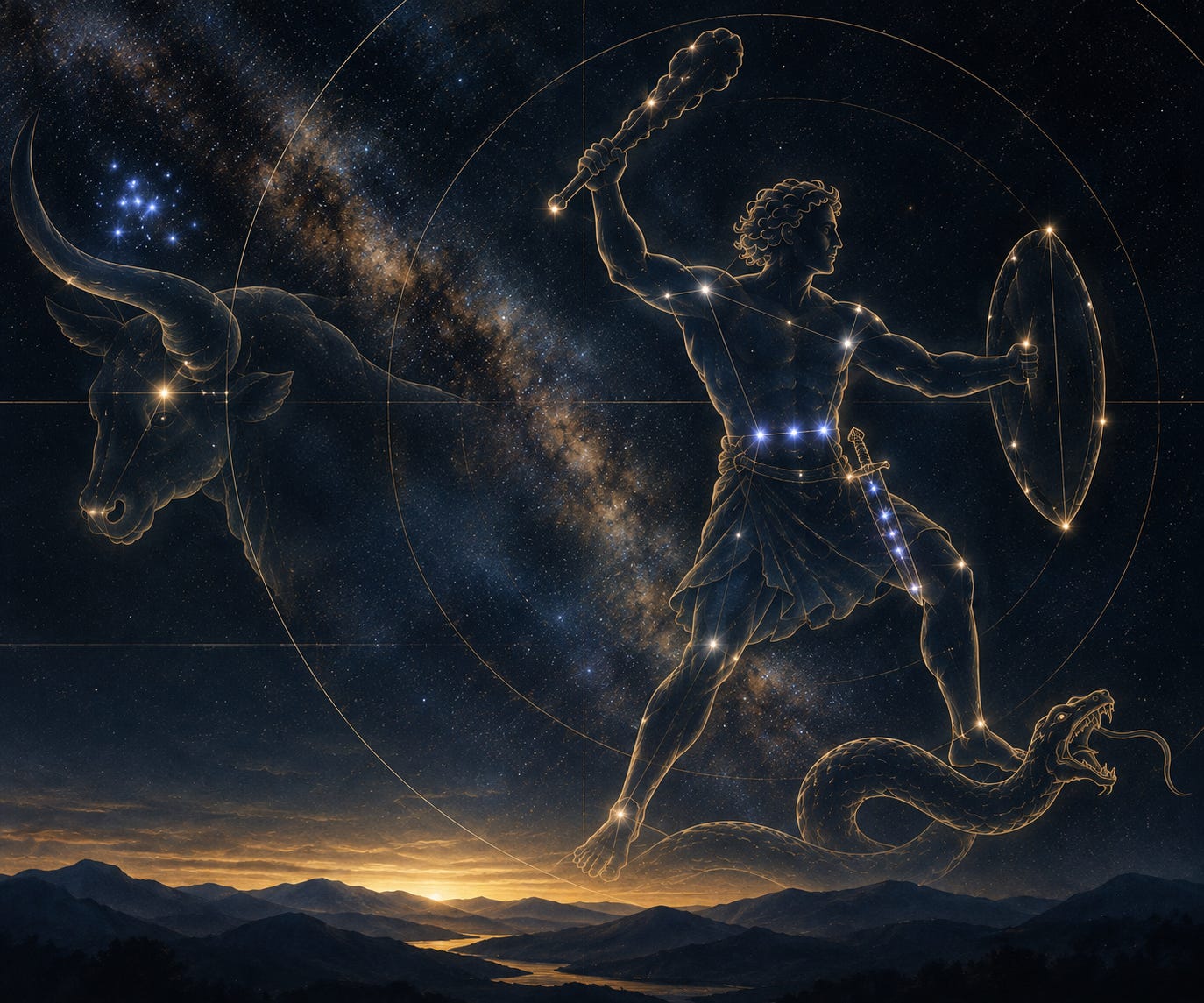
You probably know Orion even if you know very little about astronomy. On a clear winter night, the three stars of his belt are among the easiest patterns in the sky to recognize. Above and below them are four brighter stars that give shape to what generations of human beings have imagined as the shoulders and feet of an enormous man striding across the heavens.
Orion is ancient enough to be mentioned explicitly in Scripture. Job speaks of God as the One who made “the Bear, Orion, and the Pleiades,” and later God asks Job whether he can “loose the cords of Orion.” Amos likewise tells Israel to seek the One who made “the Pleiades and Orion.”
The constellation was already known since the image was so recognizable. Human beings had been looking up and seeing this enormous figure in the heavens for a very long time.
Bullinger believed Orion belonged to the larger Gospel story written through the zodiac. In his arrangement, each of the twelve primary signs is accompanied by three additional constellations that enlarge and develop its meaning. Orion belongs to the group surrounding Taurus, the great bull that Bullinger understood as an image of the Messiah coming forth in strength and glory. Orion gives that strength a face.
Bullinger called him “The Coming Prince” and described his central meaning as “Light breaking forth in the Redeemer.” I find that phrase particularly striking, because what we find in Orion is not merely the image of a warrior. We find the image of a victorious figure whose coming is associated with light.
And that immediately takes us into the Gospel of John.
“In Him was life, and the life was the Light of men.”
Before John tells us about miracles, teachings, disciples, crosses, or empty tombs, he begins with Light. The eternal Word enters creation and the darkness cannot overcome Him. The victory of Christ is presented from the beginning not merely as the defeat of an enemy, but as darkness being invaded by Light.
This gives us a better way of reading the conquering imagery that surrounds Orion. Christ does not conquer because God has suddenly become better at violence than the powers of darkness. Darkness is defeated simply because the Light has arrived on the scene. Come on now, read it again!
Jesus says, “I am the Light of the world.” His coming exposes what has been hidden, heals what has been broken, reveals what is true, and restores creation to its proper order. The Redeemer comes forth as Light.
The Wounded Conqueror
There is another dimension to Orion that makes the picture even more fascinating. Although the constellation has historically been imagined as a mighty hunter or warrior, the Gospel gives us a very particular kind of warrior—a wounded one.
This pattern has already appeared in our journey through the zodiac. The first promise of redemption in Genesis does not describe a Messiah who remains untouched by conflict. The serpent strikes His heel even as He crushes the serpent’s head.
That paradox runs through the entire Gospel. Jesus conquers through suffering. He defeats death by entering it. He exposes the weakness of violence by absorbing its full force without becoming its servant.
Even after the resurrection, He does not hide His wounds. Thomas is invited to touch the marks of crucifixion. The scars remain, but they no longer testify to defeat. They have become the marks of victory.
This changes the meaning of power. The true Conqueror is not the one who escapes suffering, but the One who passes through it without allowing suffering to determine the final word.
This is one reason the image of a great warrior in the heavens can be so easily misunderstood if we begin with ideas of conquest rather than with Christ Himself. Jesus gives us the definition of victory. His kingdom does not advance according to the logic of empire, but through self-giving love, reconciliation, truth, sacrifice, and life overcoming death from the inside out.
Beneath Orion’s foot lies another constellation. Today we know it as Lepus, the Hare. Bullinger believed the image beneath Orion may have represented something more sinister in earlier traditions—a serpent or enemy lying beneath the feet of the victorious figure. Whatever the original representation may have been, the position itself is striking.
This image appears everywhere in Scripture: the serpent beneath the heel, enemies beneath the feet of the King, and then Paul carrying the picture to its ultimate conclusion when he says that Christ “must reign until He has put all His enemies under His feet,” and that “the last enemy that will be abolished is death.”
Did you catch that last line?
The final enemy is not humanity, but death itself.
This changes how we understand the victory and judgment of Christ. The Redeemer does not come to destroy the very humanity He came to save. He comes to overthrow everything that has kept humanity in bondage: sin, death, corruption, accusation, fear, alienation, and every force that distorts the image of God within us.
The enemies beneath His feet are the very enemies that once had us beneath theirs.
A Nursery in the Sword
There is another detail about Orion that Bullinger could not have fully appreciated because modern astronomy has allowed us to see much more deeply into the constellation than the ancient world ever could.
Just beneath Orion’s three-star belt hangs what appears to the naked eye as a short line of stars traditionally called his sword. Near the center of that sword is a faint cloudy patch. This is the Orion Nebula.
What appears to us as a small haze is actually an immense region of gas and dust where new stars are actively being born.
I see such a glorious parable here… Inside the sword of the celestial warrior is a place of birth.
The instrument of conquest contains a nursery.
Hello!
Of course, ancient observers didn’t understand this. They couldn’t have known that the hazy light beneath Orion’s belt was filled with baby stars. But creation is an ongoing discovery, and the Gospel is the drink that never runs dry, so I believe fresh scientific insight just deepens the original message. So let’s think about this some more…
The Gospel transforms our understanding of divine victory. Christ does not conquer and then leave behind a wasteland of destruction. His victory creates life! He enters death and produces resurrection. He enters alienation and produces reconciliation. He enters the grave and turns it into the birthplace of a new humanity. Yes, the sword becomes a nursery… 👏
Jesus Himself described this mystery through the image of a seed falling into the ground. Unless the grain dies, He says, it remains alone. But if it dies, it produces much fruit. Death becomes multiplication, and the grave becomes a womb. 👏👏
Or here’s another way to think about it… The Cross, the great instrument of Roman execution, becomes the Tree of Life.
So there is something wonderfully fitting about looking toward Orion’s sword and finding a region where stars are being born. What looks like an instrument of death turns out to be filled with birth. This is ultimately where all divine judgment is headed. God judges darkness by turning on the Light. He judges death through resurrection. He judges alienation through reconciliation. He judges the old creation by declaring:
“Behold, I make all things new.”
The One Who Made Orion
There is one final connection that brings us back to the biblical references to Orion itself. When God finally answers Job out of the whirlwind, He directs Job’s attention upward and asks, “Can you bind the chains of the Pleiades, or loose the cords of Orion?”
The point is that Job cannot. He can recognize Orion, name it, and contemplate whatever meaning might be contained in its image, but he cannot reach into the heavens and rearrange its stars. The great figure towering above him is itself held within the infinitely greater wisdom and power of its Creator.
This is an important safeguard for everything we have been exploring in The Song of the Universe. There is a profound difference between believing that creation speaks and believing that creation rules. Scripture invites us to do the first while warning us against the second.
The stars have no authority over our lives. Orion does not determine our future, and the zodiac does not dictate our personality. These heavenly lights are themselves creatures, dependent upon the One who placed them in the heavens and continues to uphold them.
This is why every biblical mention of Orion ultimately directs our attention beyond Orion. Job says that God made Orion. Amos calls Israel to seek the One who made Orion. God Himself points toward Orion to remind Job that even this immense and glorious structure exists within a creation that He alone fully knows and sustains.
So the Christian response to the heavens is neither fear nor worship. We do not bow before the signs. We look through them.
And when Orion is viewed through the lens of the Gospel, a stunning portrait emerges: a great figure associated with strength and light, wounded yet victorious, with the enemy beneath his feet and, hidden within his sword, a nursery where new stars are being born.
Bullinger called him the Coming Prince and saw in him “Light breaking forth in the Redeemer.” Whatever conclusions we reach about the origins of every ancient constellation, the image becomes a powerful parable.
For the Gospel tells us of another Man who stepped into the darkness carrying the Light from which all things were first created. He entered the great conflict, received the wound, passed through death, and emerged victorious—gathering humanity into His own resurrected life.
This what the heavens have been doing all along. Not giving us another Gospel or supplying secret knowledge unavailable in Scripture—but taking the same eternal mystery and casting its reflections throughout creation.
The heavens declare and Scripture interprets.
And at the center of both stands Christ, the living Word. He is the One through whom the stars were made, the One in whom they continue to hold together, and the One toward whom their light continues to point.