


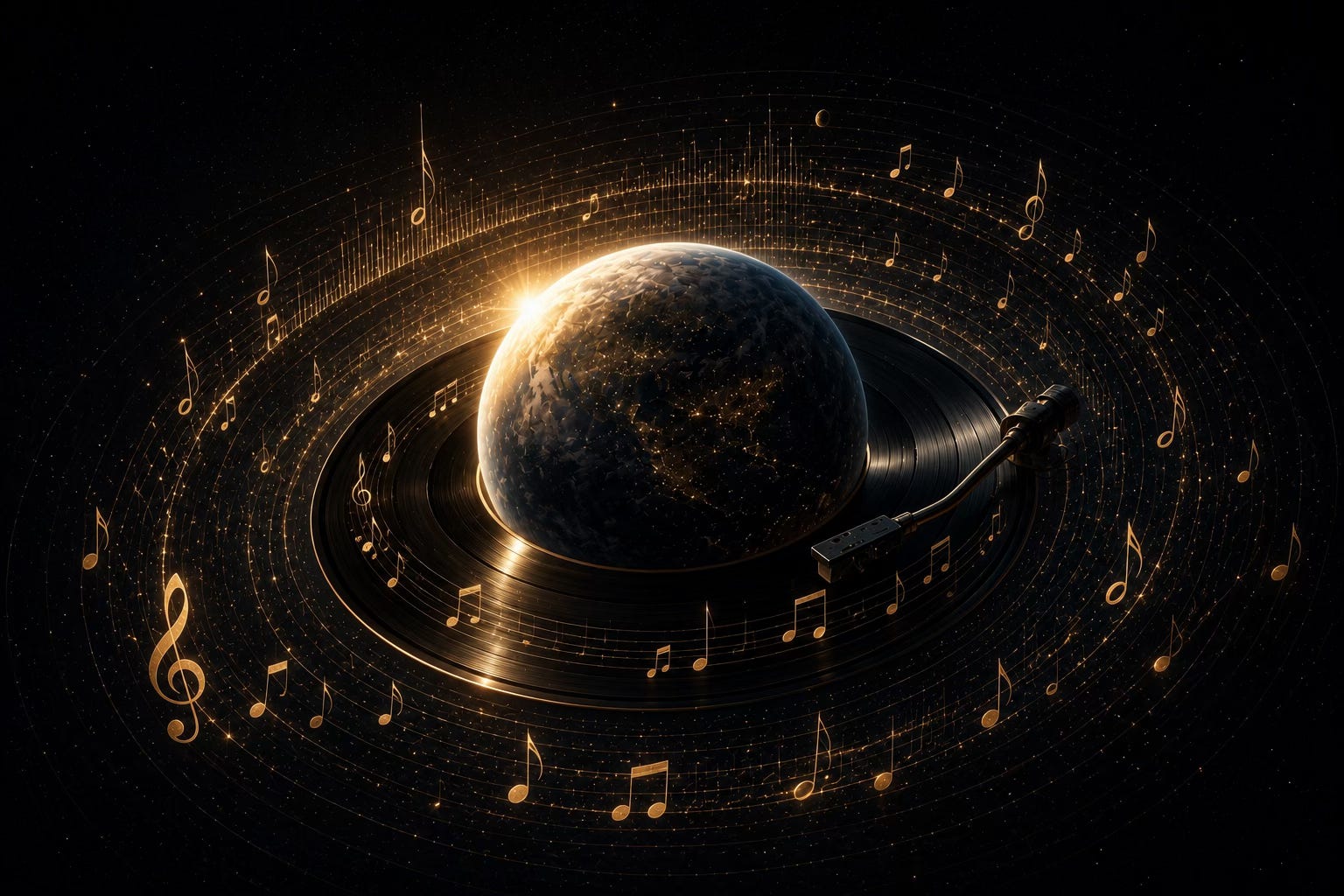
We have been exploring the universe as a kind of symbolic architecture bearing witness to the beauty of its Creator. It is an enchanted cathedral of light whose stained glass is made of living, pulsing, orbiting images, each telling parables at multiple vantage points. Each parable pointing to the eternal mystery—the Great Riddle—of its Maker.
We began this series with the Carina Nebula, where a vast stellar nursery told of a sower scattering stars like seed. We then followed the “signs” of the heavens (Gen. 1:14) to their literal fulfillment in the light that pointed to Bethlehem, the birthplace of the Messiah. From there, we considered Jesus’ own declaration that He is the “Bright and Morning Star,” the herald of a new creation whose light is now rising within us.
But the heavens do more than shine.
According to an ancient idea that has fascinated philosophers, mathematicians, astronomers, and theologians for more than two thousand years, they also sing.
The Music of the Spheres
This idea is usually associated with the Greek mathematician Pythagoras and his followers in the sixth century before Christ. The Pythagoreans discovered that musical harmony has a mathematical structure. When the length of a vibrating string is divided according to simple numerical ratios, recognizable musical intervals emerge. A string half the length of another, for example, produces the same note an octave higher. Other simple ratios produce other harmonious intervals.
This was an astonishing discovery. Something as mysterious and beautiful as music was not arbitrary. Hidden beneath what the ear experienced as harmony was an invisible mathematical order.
The Pythagoreans began to wonder whether this relationship between number and harmony extended beyond the strings of a musical instrument. Perhaps the cosmos itself was ordered according to similar proportions. The movements of the heavenly bodies, they imagined, participated in a vast harmony—a musica universalis . . . universal music.
The “music of the spheres” was not necessarily music in the ordinary sense of sound waves traveling through the air. It was the idea that the cosmos itself possessed an underlying harmony, that the movements of the heavens expressed an order analogous to music.
The Greek philosopher Plato developed the idea further, weaving music, mathematics, and the structure of the cosmos together in his vision of reality. Centuries later, the Roman philosopher Boethius distinguished between musica instrumentalis, the audible music produced by instruments; musica humana, the harmony of the human person; and musica mundana, the greater harmony of the cosmos itself.
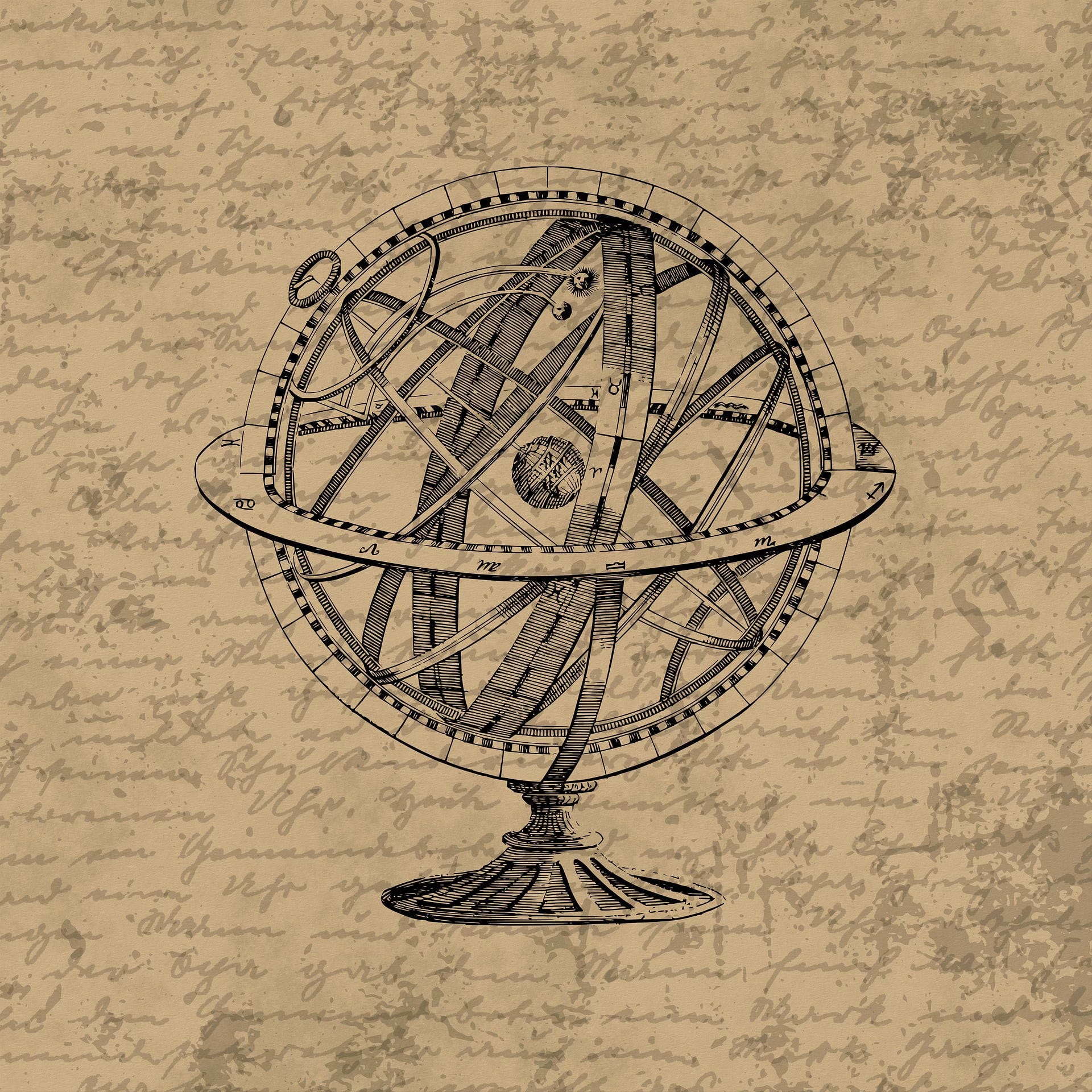
The idea survived well into the Christian era and eventually captured the imagination of Johannes Kepler, one of the great architects of modern astronomy. Kepler was convinced that the mathematical relationships governing planetary motion reflected a deeper harmony established by the Creator. In 1619, he published Harmonices Mundi—The Harmony of the World—in which he attempted to describe the movements of the planets in musical terms.
Some of the ancient cosmology behind these ideas has, of course, been replaced. The planets are not attached to transparent crystalline spheres, and outer space does not carry ordinary sound in the way the atmosphere does.
Yet the deeper intuition has proven surprisingly difficult to kill.
The more deeply we investigate the universe, the more we discover a reality filled with oscillation, waves, frequencies, rhythms, and mathematical relationships.
A Universe of Waves
Music begins with vibration. A guitar string moves back and forth, disturbing the air around it. Those disturbances travel as waves until they reach the ear, where they are translated into the experience we call sound.
But vibration and wave behavior extend beyond music.
Light itself is electromagnetic radiation described in terms of waves. Radio waves, microwaves, visible light, UV light and X-rays all belong to the same electromagnetic spectrum, distinguished by their wavelengths and frequencies. What our eyes perceive as color is our experience of a narrow portion of that vast spectrum.
Matter itself becomes stranger the more deeply we look. At the quantum level, the simple picture of reality as tiny solid objects bouncing around like microscopic billiard balls gives way to something far more mysterious. Quantum entities exhibit wave-like behavior, and modern quantum field theory describes what we call particles as “excitations” of underlying fields.
This does not mean that atoms are literally playing songs, or that physics has somehow proven Pythagoras correct. Poetic analogy should not be mistaken for scientific claim. But the analogy is nevertheless difficult to ignore. (For a further dive into this, check out this capturing of “sound” emerging from the earliest light of the universe: NASA: Sounds of the Ancient Universe.)
At increasingly fundamental levels, we have found that the universe is far less static than it appears. Reality is dynamic. Fields are excited. Waves propagate. Frequencies interact. What appears solid to our senses emerges from an underlying world that is astonishingly rhythmic and energetic.
But it is difficult to contemplate such a wondrous universe without eventually asking the question Scripture has been answering all along:
What is holding all of this together?
The Word Behind Creation
The opening of Hebrews contains one of the most staggering descriptions of Christ in the New Testament:
“He is the radiance of the glory of God and the exact imprint of his nature, and he upholds the universe by the word of his power.”
We often imagine creation as something God did a very long time ago. The idea is that God made the universe, set it in motion, and now observes it from somewhere outside. Yet Hebrews gives us a very different vision.
Christ is not merely the One who began creation—He is the One who presently upholds it.
Every star burning in a distant galaxy, every atom composing your body, every field, force, wave, and particle exists within a reality continually sustained by the “Word of God.” According to Scripture, creation does not exist independently. Rather, it is being upheld by a flow of energy that moves like breath continually filling an immeasurable flute whose countless openings become stars, planets, and people.
This vision brings us back to the astonishing opening of John’s Gospel:
“In the beginning was the Word, and the Word was with God, and the Word was God… All things were made through him, and without him was not any thing made that was made.”
John deliberately begins by going back to the words of Genesis: “In the beginning…” He takes us behind the scenes of this great beginning. Much like the ever-deepening discoveries of science, there have also been deeper discoveries throughout Scripture. Just as Kepler took us further than Pythagoras, John takes us further than Moses. He shows us that before there was light, there was something else.
Before matter, energy, space, time, frequency, vibration, or wave, there was the Word.
And this Word was not alone. The Word was with God.
Christian theology has spent centuries contemplating the depth of that little term “with.” It is a key part of Scripture’s tapestry that showcases the mystery of the Trinity: Father, Son, and Holy Spirit.
What this shows us is that before anything existed, there was communion. The Father loved the Son. The Son delighted in the Father. The Spirit was not an afterthought arriving later in the story, but eternally the Spirit of this divine dance.
A relationship was already at work before the universe had its song. And this is where the ancient dream of the “music of the spheres” finds its origin and fulfillment.
Before the First Note
Indeed, music itself requires relationship.
A note acquires much of its meaning in relation to another note. Rhythm requires relationship between moments. Harmony emerges when distinct tones exist together without losing their distinction.
Perhaps this is one reason music has always possessed such a mysterious ability to move us. Music is unity without sameness. Many notes become one song. And at the foundation of Christian revelation is a God who is One, yet not solitary. Father, Son, Spirit . . . Distinct without division. One without sameness. They are an eternal communion of love.
This is the deeper music all creation echoes.
The Pythagoreans heard mathematics in musical harmony and suspected that the same order extended into the heavens. Plato imagined a cosmos ordered according to harmony. Kepler studied the planets and searched for the music of their motions. Modern physics has revealed a universe permeated by waves, frequencies, fields, and oscillations. Each generation has listened differently.
Yet the deepest mystery is not that the universe contains harmony. It is that harmony itself has its origin in relationship. Before there was vibration, there was Voice. Before rhythm, there was delight. Before the universe possessed its structure, the Father loved the Son in the fellowship of the Spirit. Everything around us was born from a Song radiating from this already active movement—a force—of love.
Yes, the foundational reality of existence is not a lonely deity sitting in eternal isolation, ordering some complex science project called the universe and leaving it to tick away like a big clock (with an apocalyptic end-date for the ticking where he will unleash divine vengeance—though that’s for a different article).
At the heart of all things is the Divine Family: Father, Son, and Holy Spirit, eternally giving and receiving love. It was a dance and a celebration of untold joyful light, and creation emerged from this abundance. And it is now sustained by it.
Or perhaps a better word would be enchanted…
Divine Enchantment
We used this word in the beginning, but as we wrap up these thoughts, it deserves a closer look.
Though this term has been associated with spells and magic (or captivating someone with beauty), its original meaning is something much different. The word is composed of two parts: In (“into” or “upon”) and Cantare (“to sing”). It means to sing over something, though some have translated as “to sing something into being.”
This captures what the eternal Trinity did in the work of creation. With a blast of breath, the Triune Creator “enchanted” the cosmos, setting waves of light into motion that were full of order and harmony.
Galaxies formed. Stars burned. Planets turned. Life awakened. And the great cathedral was built, the glorious and living flute sparkling with music.
The Composer
So we return to where we began.
Creation truly is symbolic architecture. Every galaxy, wave, rhythm, and harmony becomes another stained-glass window in this vast cathedral of light. It appears that the ancient philosophers heard more than they knew. They perceived echoes as they peered beyond mathematics into harmony. But deeper still was relationship. And deep within this relationship was Joy. Though the Greeks called it the music of the spheres, John revealed that it was the Word.
And one day, that Word stepped onto the stage of His own symphony. The Composer entered His own composition, and the Song became flesh.
From that moment on, the universe was no longer hinting at its Maker. The One to whom every star and every wave had always pointed was now walking among us.
And now He invites us into that same Song.
The Christian life is not merely learning about the Composer, nor simply admiring the beauty of His work from a distance. It is participation. It is your own “flesh” getting caught up in the Music.
For it is through Christ, we are welcomed into the eternal communion of the Father, Son, and Holy Spirit—the very life from which every galaxy was born and by which every atom is still sustained.
💎 🌾 💎
Join us in impacting lives across the 10/40 window—your gift goes entirely to this mission. Learn more in the link below.