


I’ve spent a lot of time thinking about how much of my mother lives in me, often without my noticing. It’s not just the obvious things, like how I tell stories with too many details or how I see the world. It runs deeper than that, shaping how I love, stay, and let go. That realization has made me trace the ways her life still moves through mine.
Even before I was born, I was learning how to handle disappointment, endure hard times, forgive, and look for the good in people, even when it wasn’t obvious.
She never had to explain it, but through me, she shaped my idea of love.
What She Taught Me about Love
My mother loved with her whole heart. She never held back—she gave everything she had and kept believing in people long after others gave up. She prayed, trusted God, hoped for the best, and forgave even when others couldn’t understand why.
She could do this because she didn’t just believe the Bible—she carried verses like I Corinthians 13 in her heart. Those words guided her every day.
“Love suffers long, and is kind” and “Love beareth all things, believeth all things, hopeth all things, endureth all things.” These words mattered deeply to her, and they came to matter to me too.
Still, I think there were times when we both misunderstood what enduring love asked of us. That misunderstanding shaped what came next, and it shaped me too.
My mother showed me, again and again, how to stay. She taught me to give one more chance, to hope tomorrow could be better, and to forgive even before anyone took real responsibility.
Whether I realized it or not, I learned those lessons too. They stayed with me and shaped how I showed up in my own life.
I learned that a good woman stays, helps others, doesn’t give up, and tries to keep the peace.
All of this sounds beautiful until you realize how easy it is to lose yourself while trying to keep the peace for everyone else. That is where the pattern begins to emerge.
Inherited Patterns
I’ve done just that.
I’ve stayed too long in relationships, jobs, and friendships, always trying to keep the peace and wondering if I was the one at fault. I kept asking myself if I should call, explain, apologize, or try to be understood. The biggest question was always: Was I being too sensitive?
Maybe I should just let it go.
Thank God for scriptures like:
“The fear of man brings a snare.”
People-pleasing can look like kindness, and sometimes it really is. But other times it comes from fear of conflict, of being misunderstood, or of saying no and seeming selfish.
My mother knew these fears as well. She learned how to read people, ease tension, and keep things going, even though deep down, she sometimes felt hurt.
I learned that from her too—how to hurt without ever letting anyone know.
Burdens and Boundaries
Galatians says, “Bear one another’s burdens.”
I know how to do that. I know how to show up and help people through tough times. Being a helper comes naturally to me. I believe it’s a gift from God, and I’m grateful for it.
But it also says, “For every man shall bear his own burden.”
I misunderstood that for a very long time, and that misunderstanding changed what I carried. It blurred the line between helping and holding too much.
Certain burdens are meant to be shared, but others aren’t ours to carry.
I can love you without taking on your burdens. I can pray for you without feeling responsible for your choices. I can forgive you without letting you keep hurting me. I can care deeply and still say, “I can’t do this anymore.”
That doesn’t make my love any smaller. In fact, it makes it more truth-centered.
My Mother’s Heart - And Mine
Compassion without boundaries empties you. Loyalty without discernment keeps you stuck. Forgiveness without accountability can become a permission slip. Sometimes what I call faith is really fear of change, even when I want to call it something else.
Proverbs 3:5-6 says, “Trust in the Lord with all thine heart…..and he shall direct thy paths”.
These verses were my Mother’s favorites. I can remember her telling me these verses throughout my life.
But I understand them differently now, and that difference has changed how I hear them. It has also changed how I live with them. That shift is why these verses now lead me somewhere new.
Trusting God doesn’t mean staying. Sometimes it means waiting. Sometimes it means rebuilding. And sometimes it means walking away, which takes wisdom.
Relearning Peace
Romans says, “If it be possible, as much as lieth in you, live peaceably with all men.”
For most of my life, I missed the first part of that scripture. I heard the command, but not the condition.
“If it be possible”. Sometimes it isn’t.
Sometimes you do everything right, and peace still doesn’t come. Sometimes it requires distance, a boundary, or speaking a truth someone doesn’t want to hear. That is the part I had to learn slowly.
So much of this came through my mother—not because she taught me directly, but because she lived it. What she lived became part of me. That inheritance was both a blessing and a lesson.
She also carried things she learned to survive.
And I inherited some of them.
Things like the need to fix. The need to be needed. The tendency to stay too long. The habit of excusing what I shouldn’t. The fear of disappointing people. The belief that if I just tried harder, things would finally change.
It took me decades to learn that being needed is not the same as being loved.
Most importantly, she gave me the belief that God can redeem anything.
Love, Self, and Wholeness
Jesus said, “Love thy neighbor as thyself.”
For a long time, I only focused on loving my neighbor. But that command has two parts, and I ignored one of them, the one that asked me to love myself.
Neighbor. And self.
God never asked me to disappear to prove my love.
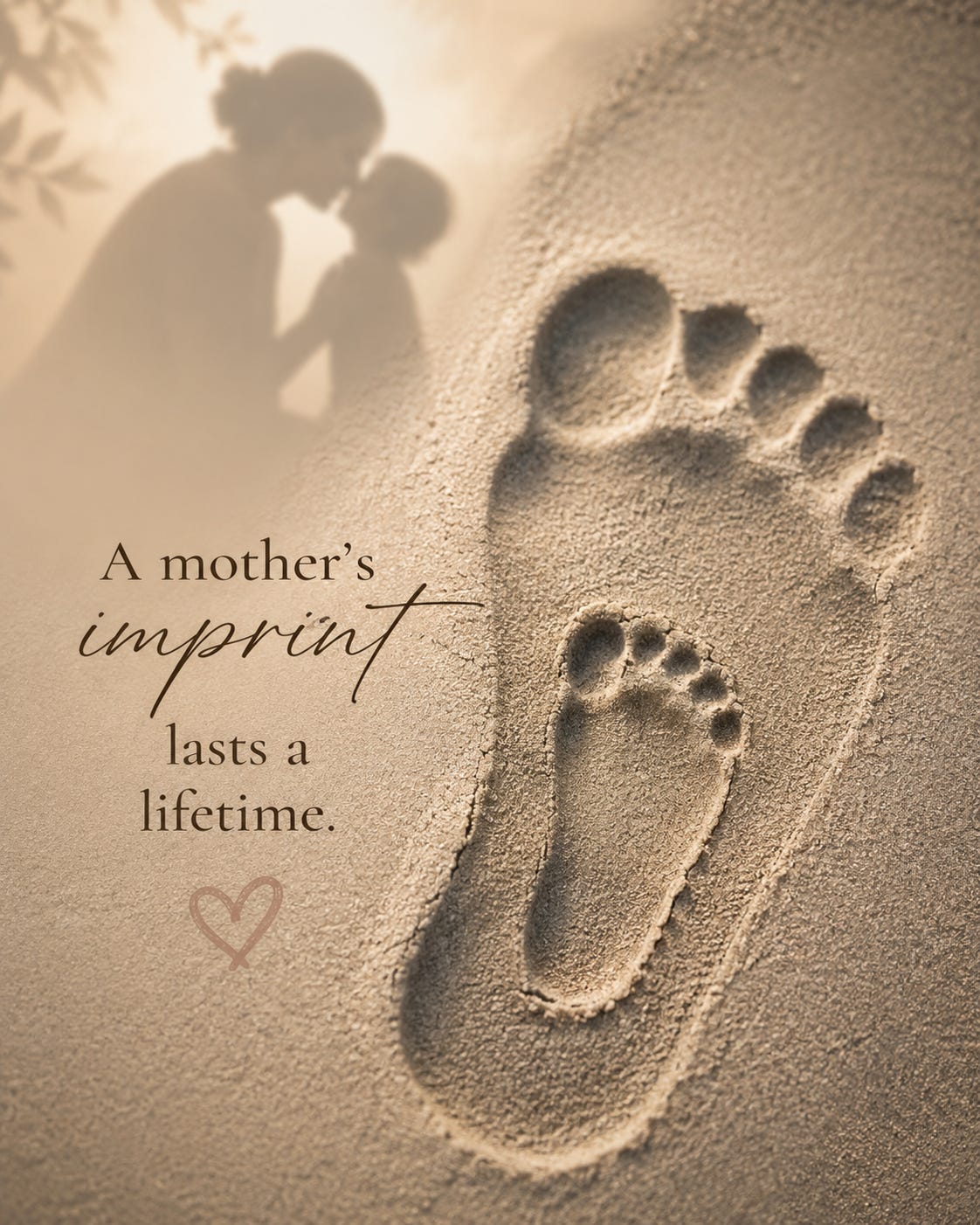
I still carry my mother’s imprint, and I hope I always will. I hear her in my prayers. I see her in my compassion. I feel her in my persistence.
But an imprint is not a sentence, and that is where the change begins. What I inherited does not have to define what I become. From there, I can choose what to keep and what to release.
Romans says we are “transformed by the renewing of your mind”.
This means patterns can change. What has been handed down can be examined, and what we keep is separated from what we release. That is how I begin to live differently.
This I will keep. This I will give back to God. This ends with me.
I don’t think this dishonors my mother in any way. I think it honors her by telling the truth about all of it, including what I had to learn and why.
What I Am Still Learning
Maybe this is what daughters learn over time. We stop focusing just on the choices our mothers made and start trying to understand what led them to those decisions.
Now I see my mother in a new way. I see the young woman she used to be, her hope, her faith, and her fear. I see how much she wanted things to work and how strongly she believed people could change. Most of all, I feel compassion for all of it.
When I notice those same patterns in myself, I realize I have a choice she might not have known was possible.
I get to decide what happens next.
I am still learning as I go.
I am learning when to stay and when to leave, when to speak up and when to listen, when to help and when to step back. I am learning when to carry someone else’s burden and when to let them handle what is theirs.
But here is what I know now:
Love can last through hard times.
Love can endure.
Love can hope.
But love also finds joy in truth.
For a long time, I understood how to endure more than I understood the importance of truth.
Now I see that they go hand in hand.
Sometimes love means saying:
I love you.
I forgive you.
I will pray for you.
But I cannot keep living like this.
There was a time when I thought saying those words meant love had failed.
I do not believe that anymore.
Sometimes leaving is not a lack of love. Sometimes setting a boundary is not being bitter. Sometimes saying ‘no more’ does not mean you have not forgiven.
Sometimes it is just the moment when we finally stop mixing up suffering with being faithful.
My mother left a mark on me that I will carry forever. I carry her faith, her compassion, her perseverance, and her way of seeing something worth loving in people when others could not. I also carry her belief that God can redeem what seems beyond hope.
These are the parts of her influence that I treasure.
And the other parts, like fear, people-pleasing, staying too long, and believing that love means accepting what hurts us, I can give those to God.
This I will keep.
This I will give back to God.
This ends with me.
Maybe that is part of God’s redemption too.
It is not about erasing my mother’s influence, but letting God transform it.
In the end, I am learning that love and truth are not meant to be in conflict.
Real love makes space for both.
💎 🌾 💎
Join us in impacting lives across the 10/40 window—your gift goes entirely to this mission. Learn more in the link below.