


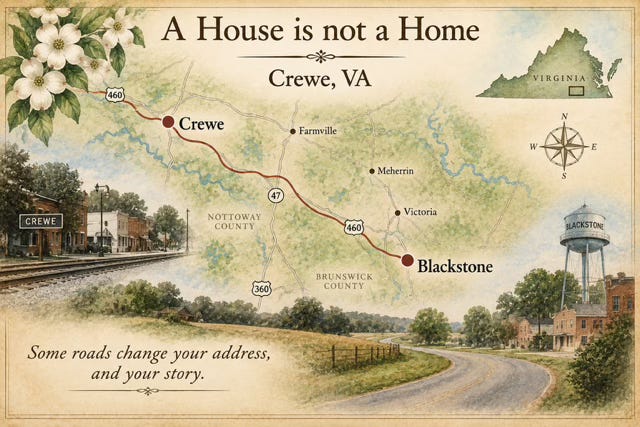
The cycle of my parents separating and reuniting began shortly after I was born, with my father spending periods of time either hospitalized or in prison. Because we urgently needed shelter, we lived with my mother’s parents.
That arrangement came with its own set of challenges.
My mother’s father was an abusive man who never overcame his anger and rage. Instead, he took his internal conflicts out on those closest to him. Living with her parents gave us a roof over our heads, but it came at a great cost—emotionally and physically.
My father worked to assure my mother that things would be different once he was released from the psychiatric hospital. Now that he was medicated, he told her, the erratic behavior was behind him. The medication had addressed the problems that landed him in the hospital, and they could finally put it all behind them.
My father’s father, whom we called Dada, was also working to repair the damage. He used his resources and connections to find his son a new church home where he might have a fresh start and thrive as a musician.
His tenacity paid off.
By the time my father was released, Dada had secured him a job at a small church in Crewe, Virginia.
New Beginnings
Once my father had the church job, the next priority was finding us a place to live. We had very few financial resources until he began earning money, so one of the families at the church—the Crenshaws—offered us a trailer on the property where their trucking business was located.
It would give us somewhere to live until we could afford to rent a house.
My mother remembered paying only twenty-five dollars a month for the trailer.
She was in her third trimester of pregnancy with my brother, teaching voice and piano lessons, caring for me, and trying to help my father establish himself in a new community. In reality, she was caring for all of us, with very little time or energy left for herself.
The Crenshaws’ daughter, who was still in high school, would sometimes come in the afternoons to help. She would take me for walks, giving my mother a little time to rest.
After my brother Christopher was born, the search for a larger place became more urgent. The trailer had been an economical solution and an incredible kindness, but it was never meant to be a permanent home for a growing family.
Eventually, my parents found a house that seemed like the perfect fit.
There was only one problem.
It was undergoing a complete renovation.
After a lengthy wait, we finally moved into our newly renovated house.
It was an older, two-story home with all of the bedrooms upstairs. At the top of the staircase, a large bathroom sat immediately to the right. Beyond it was my parents’ bedroom, a spacious room with a small, unusual area attached. It had originally been a closet, but during the renovation the landlord had removed the door, opened the space, and added a window.
That little room became Christopher’s nursery.
It was just large enough for his crib.
Across the hallway were two more bedrooms. One became the guest room, and the other was mine.
I was three years old and, for the first time, had my own room. It had a window, room for my toys and clothes, and a closet with folding doors. It was close enough to my parents’ bedroom that my mother could cross the hallway quickly if I needed her during the night.
I have no memory of that house.
Which is probably a good thing.
Two O’Clock
My mother arranged our days around her teaching schedule. After lunch, she would put Christopher and me down for naps so she could rest before her afternoon students arrived.
She remembered being tired in every way possible—physically, mentally, and emotionally. Those afternoon rests were important to her well-being.
But she soon discovered that resting at two o’clock would not be easy.
One afternoon, a loud bang startled her awake.
It drove her straight out of bed and onto her feet.
Christopher and I were still sleeping.
Her first thought was that someone had fired a gun nearby. She stood listening.
Nothing.
No screaming. No commotion outside. No police sirens. Nothing to suggest that anything had happened at all.
She convinced herself she must have been dreaming.
Then it happened again.
And again.
Always in the afternoon.
Always around two o’clock.
Eventually, she told my father what had been happening.
He dismissed it.
“You were probably dreaming.”
It was the first indication that something was happening in that house.
Something’s Not Right
Then I began waking during the night.
I would stand in my bed screaming.
“There’s a man in my closet!”
My mother would come into my room, turn on the light, and show me there was no one there. She would close the folding closet doors and try to reassure me.
But it kept happening.
Some nights I became so frightened that she would take me into her bedroom, and I would sleep with my parents.
Then other strange things began happening.
The lights seemed to have a mind of their own.
One of our babysitters was a beautiful young girl from the church whom Christopher and I adored. She had been born with one arm shorter than the other, something my mother remembered only because other people sometimes saw it as an impediment to her caring for us.
My mother never did.
The babysitter began noticing the lights.
At first, she assumed she had forgotten to turn them off. Eventually, though, she became certain she hadn’t.
“Mrs. Sinclair, I know I turned those lights off, and they are back on.”
Seeing the fear in the young woman’s eyes, my mother tried to reassure her. The house had just been remodeled, she reasoned. Perhaps something had been wired incorrectly.
But the lights were only the beginning.
Coats that had been hung on the coat rack would later be found lying across the back of the couch.
Dirty dishes would somehow be washed and left to dry.
Objects deliberately placed in one location would turn up somewhere else.
By then, explanations were becoming harder to find.
To my mother, something was occupying that house with us.
Plain and simple.
Water with No Source
One night, water began dripping through the kitchen ceiling.
My mother called the landlord, who instructed her to poke a small hole in the ceiling where the water was collecting and place a pan beneath it until he could investigate.
But when they examined the leak, they found no source.
It wasn’t near any known water pipes. Nothing had leaked or overflowed on the second floor. Eventually, they patched the opening in the ceiling.
The next day, my mother found a black widow spider sitting on top of the washing machine.
Between the unexplained noises, the lights, the water, the spider, two small children, her teaching schedule, and everything already happening in her marriage, the house seemed determined not to give her a moment of peace.
But none of those things compared to what happened one Sunday night upstairs.
The Man in the Bedroom
My mother had taken Christopher and me upstairs for our baths.
After bathing us, she realized Christopher needed a diaper. She stepped into the adjoining bedroom for just a moment to retrieve one from the chest of drawers where they were kept.
When she turned around, a man was standing in the room.
At first, her mind registered him as my father.
She spoke to him naturally.
“What are you doing up here? I thought you were cleaning up the kitchen.”
The man didn’t answer.
She looked at him again.
Dark pants.
A belt.
A light blue denim shirt.
Black hair.
Something was wrong.
It wasn’t my father.
The moment her mind processed what she was seeing, she ran downstairs.
My father was standing in the kitchen washing dishes.
He had never left.
“Angharad, what’s wrong?” he asked.
He could see that all the color had drained from her face.
Then he realized something else.
“Where are the children?”
He raced upstairs, terrified something had happened to us.
He found Christopher and me sitting in the drained bathtub, waiting for our mother to come back and dress us.
For the first time, whatever my mother believed was occupying that house had materialized directly in front of her.
A Picture Is Worth a Thousand Words
One of my mother’s piano students was a young girl whose family had a connection to the house.
One day, during a casual conversation, the girl and her mother brought it up.
“This is where my grandfather lived.”
That simple statement opened the door for my mother to begin asking questions.
The girl’s grandfather, Mr. Chappell, had worked for the railroad. He had been badly injured while working and lost his leg. According to his family and people in the community, the loss changed him profoundly. He fell into a deep depression and eventually took his own life.
In the house.
My mother asked the girl to bring a photograph of her grandfather to her next lesson.
She did.
My mother looked at the picture.
It was him.
The man she had seen standing in the upstairs bedroom.
She recognized him immediately.
Everyone Knew
Perhaps the most disturbing part of the story was what my mother discovered afterward.
Everyone knew.
The neighbors knew.
People at the church knew.
The landlord knew.
The house had a reputation, and no one seemed to stay there very long.
Fortunately, my mother met a woman named Mrs. Moore.
Mrs. Moore’s husband had once been a pastor in Crewe, and she knew the community well. She knew its families, its churches, and apparently many of its secrets.
When she learned where we were living and heard what had been happening, she didn’t hesitate.
“That house is haunted, and we’ve got to get you out of there.”
Mrs. Moore helped open the door for our next move—to Blackstone, just a short distance up the road.
For my mother, those were good doors to open.
They offered the possibility of a fresh beginning—a chance to leave Crewe, and everything that had happened there, behind us.
But some doors are easier to close than others.
My mother came to believe that something more than a troubled house had touched our family during our time in Crewe. She believed spiritual doors had been opened there—doors connected to darkness, depression, and ultimately, suicide.
At the time, none of us could have known how significant that belief would become.
We packed our belongings and left the house behind, believing we were escaping whatever had occupied it.
Years later, our family would experience losses that made the story of Mr. Chappell—and the house in Crewe—feel far more haunting than it ever had before.
We left Crewe.
But in my mother’s heart, the question of whether Crewe ever completely left us would remain.
Join us in impacting lives across the 10/40 window—your gift goes entirely to this mission. Learn more in the link below.